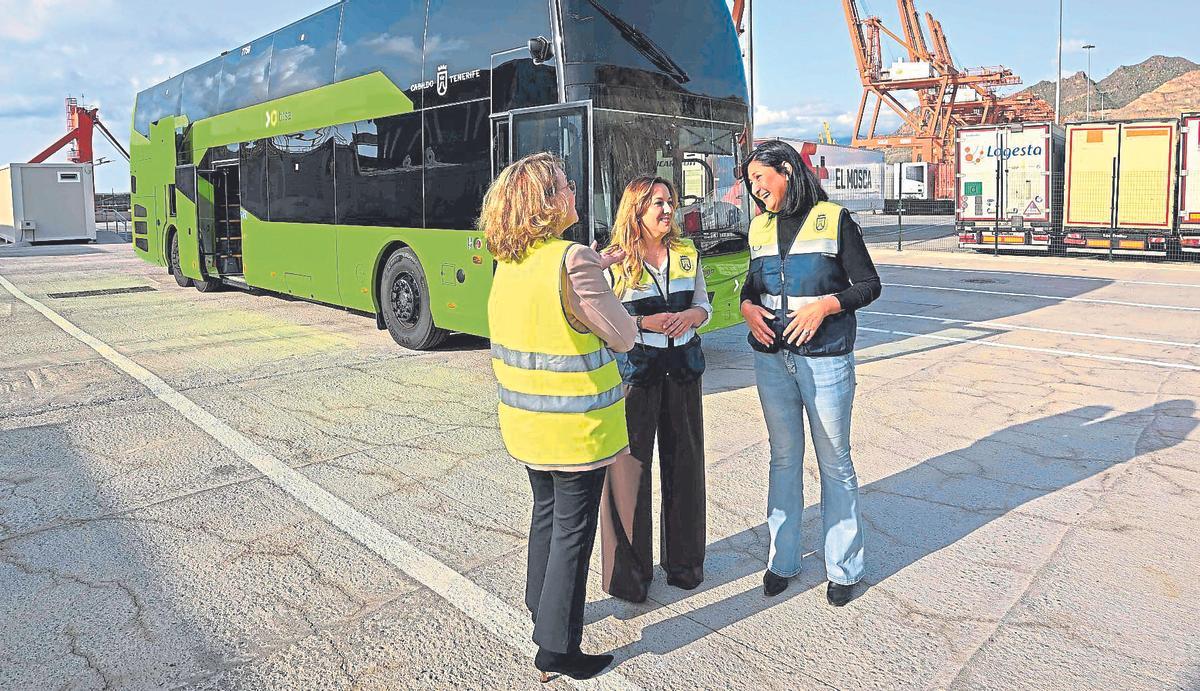
Tenerife has taken a significant step in enhancing its public transport system with the introduction of its first double-decker buses. The new vehicles are now operating along the southern motorway (TF-1), aimed at increasing the capacity of Titsa’s services and improving mobility across the island.
This week, two double-deckers began service on routes 110, which runs from Santa Cruz to Costa Adeje, and 112, from Santa Cruz to Los Cristianos. Eventually, 13 of these buses will be added, including services along the northern motorway on route 108, linking Icod de los Vinos to the capital.
Rosa Dávila, President of the Tenerife Cabildo, described this initiative as “an unprecedented leap” in the island’s public transport offerings. The introduction of the double-decker buses will boost capacity on these routes by 44%, increasing seating from 59 to 85.
Dávila noted that the 110, 112, and 108 routes transported four million passengers in 2025, and the new buses will provide an additional two million seats annually, raising the potential capacity to six million travellers.
The selected routes are primarily direct services catering to workers and young students. In 2025, over 3.7 million of the four million users on these lines were residents.
Dávila emphasized the need for improved island mobility, highlighting that Tenerife has welcomed 351 new buses in the past three years. She stressed the importance of encouraging more people to leave their cars at home.
Eulalia García, the island’s Mobility Councillor, reiterated that extensive resources have been deployed to modernise and expand the public transport network. In 2025, bus capacity surpassed 160 million seats, the highest ever, with distance travelled also breaking records at over 40 million kilometres. This growth led to more than 87 million bus users in 2025, a 6.13% rise from the previous year, partly due to the free public transport policy for regular travellers.
The new double-decker buses are more than four metres tall and 15 metres long, weighing up to 26,000 kg when full. They feature advanced technology and safety systems, necessitating thorough training for drivers.
In total, 90 staff members will undergo specific training to familiarize themselves with the new vehicles, 60 of whom have already completed the programme.
The buses include high-definition side cameras to assist drivers and eliminate blind spots, an Alcolock device to prevent operation if a driver is over the alcohol limit, and systems for lane departure warnings and automatic emergency braking. Additionally, each bus offers individual seatbelts, USB ports for device charging, and free Wi-Fi.
Accessibility is also a priority, with double access ramps for those with reduced mobility and special lighting to assist visually impaired passengers.
The fleet renewal continues, with an additional 57 new buses expected this year, and 25 more anticipated by 2027, five of which will be double-deckers. In total, Tenerife will have 351 new buses, backed by a historical investment exceeding €125 million, making Titsa’s fleet one of the most modern in the country, averaging just three years old.