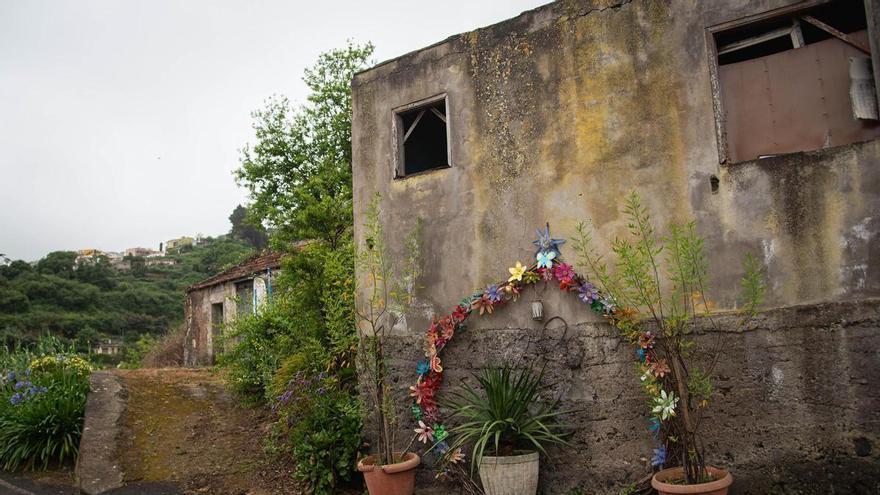
La Florida: A Hidden Gem in Los Realejos
La Florida is located in Los Realejos. Yes, even though this name is often generically associated with the neighbouring municipality of La Orotava. Nestled beneath the Tigaiga massif, this hidden paradise is home to seven or eight houses scattered along a narrow road. Only a couple are occupied permanently, while the rest serve as second homes. In La Florida, barely ten people remain.
The First Official Inhabitants
The discovery and narrative of this historical place is shared by researcher José Gregorio Hernández González. His curiosity drives him to unearth demographic treasures like this, where depopulation is a key issue. Yet life continues to flourish even among the walls. The very name reflects the botanical richness of the area, where wild lilies grow alongside chestnut trees and the most primitive laurisilva of Tenerife. It’s both wonderful and mysterious. Fog sneaks into the ravines surrounding La Florida, caressing the heights of the La Tarasca cliff. Silence envelops everything, interrupted only by the bleating of a goat or the songs of birds, mingling in the silent dialogue of the place. The animal whose sound you hear can also be seen, greeting visitors from a pathway.
Following this, the young owner of one of the homes has chosen to live in a place his parents established as a recreational area, making it his daily routine alongside his partner. Does he know who the first people to officially reside in this picturesque enclave were? Thanks to the researcher from Los Realejos, this detail is traced back to 1862, the year of the municipal register, where three surnames are listed as having established themselves in La Florida: Mosegue, Linares, and Febles. They lived in pajares, a type of dwelling that has now vanished but was part of the traditional housing arrangement in the Canary Islands for centuries. This way of life was complemented by adjacent caves, expanding their living spaces. Later, in the late 19th and early 20th centuries, new families returned from Cuba and constructed single-storey homes covered with Arabic tiles on the acquired land. Some of their descendants still inhabit La Florida.
One such descendant is José Manuel Hernández González. He works the land, proudly stating, “I was born here.” With a hoe in hand, glasses perched on his nose, and a green cap, he reflects on his great-grandmother, one of the returnees from Cuba who decided to settle in the hamlet. To this day, her lineage remains in the area. José Manuel is among the few who determined that living in La Florida was the best choice. It’s important to note that the community is merely 15 minutes from the centre of Los Realejos, so it cannot be considered isolated. The road connecting it to the rest of the municipality is decent but quite narrow.
Long before José Manuel’s great-grandmother returned from Cuba, and even earlier than the surnames Febles, Linares, and Mosegue were recorded in the register, La Florida had already ‘bloomed’. Following the conquest, the Hacienda del Adelantado and Los Príncipes were the main references for land distribution in Los Realejos. The hamlet formed part of an agricultural structure that was based on water control—a resource abundant in the area and key to its development. This fact also meant that the indigenous people shared a logic similar to that of their exterminators, as the region was part of a guanche settlement belonging to the Menceyato of Taoro.
The Importance of Toponymy
Toponymy permeates José Gregorio’s vocabulary, and looking at any corner reveals names resonating in the researcher’s voice: Barranco del Garabato, la Hondura, Barranco de Romero, Salto Romero, the cliff of La Tarasca, Villanueva, Los Zarzales, El Tanquillo, Placeres, Toscas de Romero, or Barranco La Calera, among others. The true danger of these names lies in their potential disappearance. He warns that the loss of oral sources diminishes the chances of their survival unless a rescue of spoken memory is undertaken, something that excites him and drives him to explore these corners of his municipality. They are filled with ethnography and a past that will never return. It will not return, but it need not disappear entirely.
The presence of chestnut trees in La Florida was a key element in its economic development. They formed the basis of basketry. Today, intertwined with the laurisilva regaining what once belonged to it, several remnants of this symbolic tree remain. José Gregorio explains that cuts were made to the chestnut shoots or ropes to obtain the raw materials later used for baskets. Each family had land where they would cut the shoots in winter, using them later in basketry. Men were responsible for cutting, while women crafted an essential item that now serves as decoration but was vital for agricultural tasks or transporting goods back then.
The discipline that studies, records, and catalogues place names—toponymy once again—is not a mere whim. La Florida is named as such because it is a genuine “garden of unparalleled beauty,” as articulated in the pasodoble ‘Islas Canarias’. It is the private garden on the street for those who decide to settle in this area of Los Realejos. As always, human beings cling to the resources provided by their surroundings. According to the researcher, the flowers served as an economic escape for many women in nearby communities. Flower sellers sourced their products from La Florida and, on many occasions, would travel down to Puerto de la Cruz to earn an income. Violets, lilies, aromatic plants, along with other local products such as watercress and wild strawberries, filled the baskets carried on their heads as they walked. They often positioned themselves in present-day Plaza de Europa in the port town, where the Town Hall stands today, or would visit homes offering a unique product that was often difficult to find in stores: flowers. Over the years, with the arrival of tourism, flowers from La Florida were sold to tourists who made Puerto de la Cruz the epicentre of the sector in Tenerife during the 1960s and 70s. Women established market stalls, and their work professionalised with the emergence of florists.
There is nothing quite like entering the pathway, brushing your fingers against the wild flora that requires no irrigation. And without hesitation, delicately plucking a petal from a lily, aware of its value, bringing it to your nose to breathe deeply, and finally uncovering a hidden garden in the heart of Los Realejos.