Technical Glitch Disrupts Papal Return from Tenerife
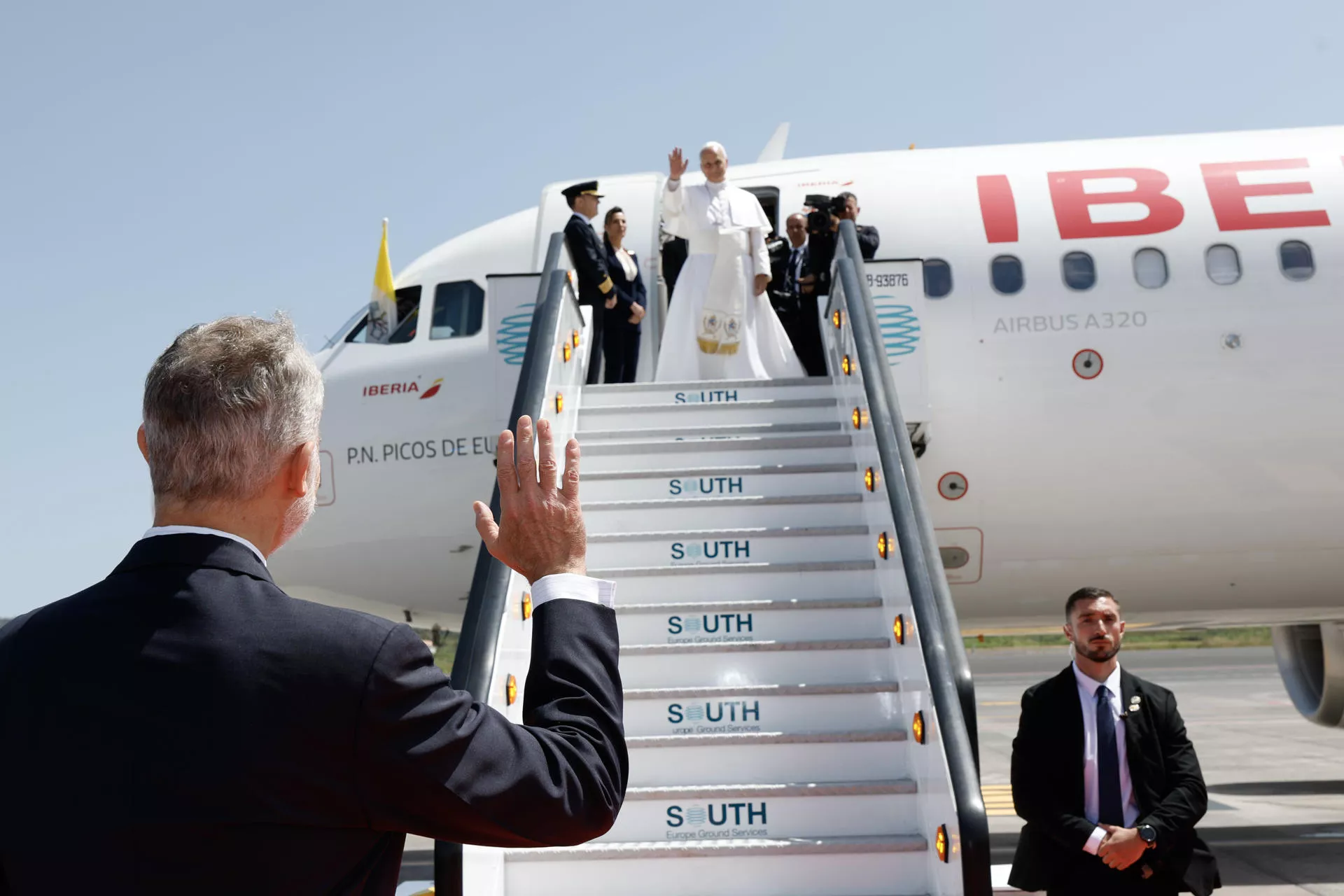
On Friday, a technical fault in the Iberia aircraft, Parque Nacional Picos de Europa, which was scheduled to bring Pope Leo XIV back to Rome from Tenerife, unjustly overshadowed a meticulously planned operation. This operation aimed to facilitate the Pope’s whirlwind visit to Gran Canaria and Tenerife. Moments before take-off, with the Pope and his entourage aboard, a technical issue arose. This compelled the evacuation of His Holiness and subsequently all passengers for checks.
The Royal Falcon
For a brief period, Iberia’s handling push-back machines attempted to turn the aircraft around and start the engines, suspecting that air intake issues might have caused the malfunction. Ultimately, a decisive plan was executed: the Pope was transferred to King Felipe VI’s Falcon for his return to Rome, while another Iberia plane was requested from Madrid to be taken later by the King and accompanying journalists.
The Operation
Despite this unexpected incident, the papal visit to the Canary Islands involved a complex airport operation that mobilised dozens of workers over two days. This required coordination between civilian and military facilities and activated unusual security protocols at the archipelago’s airports. Antonio Núñez Piñeiro, South’s representative in the Canaries, detailed for Atlántico Hoy the behind-the-scenes efforts that began long before the Pope set foot on Canarian soil.
Operation Starts in Gando
The first unique aspect occurred on Thursday when the Iberia Airbus A321, named Peñón de Ifach, landed on the military section of Gando Air Base in Gran Canaria. Unlike a regular commercial flight, the handling company had to coordinate with Aena and military officials to transfer all necessary equipment from the civilian platform to the military area. “We had to liaise with the military captain and Aena to determine the best timing for moving the equipment,” explained Núñez Piñeiro.
This was no small task; vehicles had to navigate areas close to the runway and make use of specific operational windows to avoid disrupting air traffic. Once the aircraft was parked, another unique protocol began. Before Pope Leo XIV could disembark via the main door, Vatican security and part of his entourage exited through the rear to inspect the surroundings.
Security First
“Security must disembark first to ensure everything is in order,” recounted Núñez Piñeiro. Only after receiving the green light did the front stairs get installed, allowing the Holy Father to appear. This procedure repeated at each airport throughout the journey, marking a significant difference from conventional operations. The priority was always to ensure the perimeter was secure before any movement of the Pope.
The Peñón de Ifach Returns to Madrid
Moreover, the Peñón de Ifach did not remain in the Canaries. After offloading the luggage of the papal entourage and accredited journalists, it left the archipelago empty for Madrid on a repositioning flight. This detail was particularly pertinent given the technical difficulties faced on Friday at Tenerife Norte. The aircraft that encountered issues while departing for Rome was not the same one that had brought the Pope to the Canaries the previous day. According to Núñez Piñeiro, the aircraft used for arrival had returned to the mainland after dropping off the Pontiff in Gran Canaria.
For Friday, Iberia dispatched the Parque Nacional Picos de Europa from Madrid, which landed early in Gando to collect the Pope and then transport him to Tenerife Norte. Unlike Thursday, this second aircraft remained parked at Tenerife airport throughout the day alongside the King’s Falcon.
A Dedicated Airport for the Pope
The stay at Tenerife Norte necessitated another extraordinary operation. Authorities reserved the area of the old airport terminal (now occupied by the Civil Guard) where no other aircraft could park. The perimeter was locked down, allowing only authorised personnel to access the flight, along with the Civil Guard and Vatican security. “Only those of us authorised to handle the aircraft can operate,” summarised Núñez Piñeiro.
This restriction impacted regular airport activities. With part of the platform unavailable for other airlines, some aircraft had to be relocated to remote positions, increasing the operational complexity of an already busy facility. On Friday, another 286 flights operated at Tenerife Norte.
A Team Ready for Fog
Weather also posed a significant concern for organisers. With the ever-present possibility of fog complicating operations at Tenerife Norte, South kept an alternative plan activated at Tenerife South. “We have an exclusive team ready to assist if the flight diverts,” explained the company representative. Personnel, vehicles, and equipment remained on standby at Reina Sofía throughout the day to respond to any last-minute changes. Coordination, he noted, was ongoing among Aena, Civil Guard, airport officials, military authorities, and Vatican security. This discreet and largely invisible work ensured that every movement of the Pope went according to plan.
When Everything Seemed Concluded
Then came the technical fault. Paradoxically, the only hiccup in a meticulously planned visit occurred when the complex logistical operation that had transported the Pontiff from Gran Canaria to Tenerife was nearing completion. “We are quite proud to have managed this flight,” said Núñez Piñeiro, a sentiment shared by the workers who contributed to this historic operation, transforming Canarian airports into the logistical hub for one of the most significant travels of the papacy.