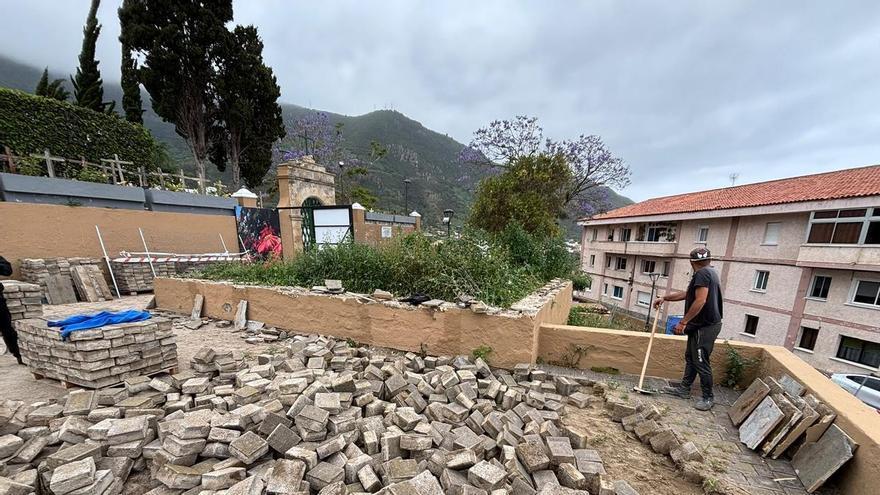
The Los Realejos Town Council will plant a new dragon tree in the location where the iconic specimen of the San Francisco cemetery stood. The century-old tree fell last March, crushing six vehicles but fortunately causing no personal injuries. However, this event resulted in a significant botanical loss for the municipality. Three months later, work has commenced on replacing the wall of the cemetery, which collapsed along with the tree, also known as the Buenpaso Dragon. This initiative is based on the vital needs of an individual of the endemic Macaronesian species, dracaena draco.
The new specimen will arrive in six weeks, during July. It measures approximately four and a half metres in height and is currently located in a public space maintained by the council, which is already preparing the ground by digging a trench around it to ready its roots for adaptation before the final relocation. This effort to replace the fallen dragon tree is supported by botanical specialists. “We were informed that any specimen of this tree must not be excessively large or have too voluminous a canopy. It has to be lifted with a crane, transported by truck, and staked,” explains Adolfo González, the mayor of Los Realejos (PP). “Ultimately, we found a dragon tree that meets the necessary conditions. The specialists reviewed it and believe it has good morphology, and they are confident it will adapt well to its new location,” he adds.
The project at the entrance of the San Francisco cemetery will increase the available land area for the dragon tree’s expansion. González explains that the previous specimen had a problem as it “was confined within a planter. With such a stature, it did not have sufficient space for its roots to grow adequately.” The work will transform the square into a land area that must meet certain quality standards. The specialists also indicated the necessary way to conduct the enclosure, which includes adding drainage. “It is essential to prevent moisture from accumulating at the base of the new dragon tree as this is detrimental to its foundation,” he warns.
A Catalogue for Protection
Replanting a dragon tree in place of another is not sufficient for the protection and development of native flora. Therefore, the Los Realejos Town Council is working on creating a municipal catalogue of botanical elements or species of interest, which will be available by the end of this year or early next year. Each specimen will be registered in this inventory and assigned a level of protection for monitoring, even if situated within private property. This is crucial as González states, “With this catalogue and the level of protection it grants each element, we will be able to require property owners to maintain and monitor the specimens located within their homes or estates.” He compares it to existing tools for safeguarding buildings in poor condition, emphasising, “With catalogued botanical components, we aim to gain similar authority to enforce their protection.” He recalls the dragon trees located on private lands, such as the ones at the Siete Fuentes estate or the one at Rambla del Mar, which also fell last May.
In the case of the latter specimen, the local government highlights the challenge of ensuring protection. “We spoke with the owners and warned them that they needed to take action due to observable deterioration. Subsequently, the ownership changed. We also spoke with the new owners, but apparently, there was insufficient interest in preserving it,” the mayor states. “We can issue warnings, make recommendations, or attempt to mediate, but until there is a specific legal tool in place, our ability to enforce action on a specimen located on private property is highly limited,” he admits.
Why Did the San Francisco Dragon Tree Fall?
The iconic dragon tree at the San Francisco cemetery fell due to the weight of its canopy. This is the primary cause detailed in reports regarding the tree’s morphology and potential reasons for its collapse. Heavy rains this winter accumulated in the upper part of the tree, and “the trunk could not bear the weight. The fact that it was confined within a planter and lacked adequate space for root development contributed to its downfall,” confirms González.
“The new specimen will not, in any way, substitute the symbolism or history of the old dragon tree of San Francisco,” the mayor acknowledges. Many locals offered specimens to plant in its place, while others collected cuttings from the fallen tree to plant and potentially grow ‘offspring’. However, “even if some thrive, nothing can replace all that the previous tree represented for Los Realejos.” A mural and a sculptural ensemble—an exact scaled-down replica to be installed during the summer—will forever commemorate the presence of the San Francisco dragon tree at that site.