Romería in Honour of San Isidro and Santa María de la Cabeza in La Orotava
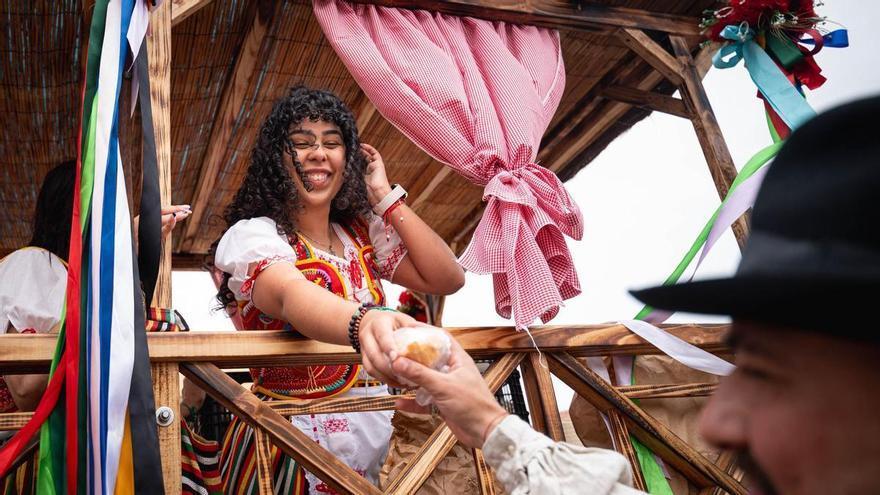
The pilgrimage in honour of San Isidro and Santa María de la Cabeza in the Villa of La Orotava is a revered ritual. This authentic demonstration of respect for tradition was initiated by César Hernández Martínez in 1936 and is still alive today, attracting more than 30,000 people who gathered this Sunday for its latest edition. It was a cloudy but humid day, filled only with joy and excitement.
The Start of the Pilgrimage
Although the pilgrimage departed at 1:30 PM from San Francisco, the ritual begins much earlier. Witnessing San Isidro and Santa María de la Cabeza emerge, accompanied by farmers and a brass band, from the church of La Concepción is a special and solemn moment. “It’s the start of the pilgrimage. The excitement of seeing them emerge, of witnessing the farmers with their decorated staves. It’s the moment when the butterflies flutter in your stomach, and you know the fun is about to begin,” says Conchi Díaz outside the Marian temple. She is with a group of friends, all impeccably dressed, paying attention to every detail: the men in leather gaiters and the women adorned with yellow headscarves, hats, and green capes draped over their right shoulders. “It’s traditional dress. This is not carnival, and we aren’t here to show off. I feel we often talk about our Canarian identity, but when it comes down to it, we often ignore it because it doesn’t suit us,” she criticises.
The Procession
Then, the bells ring, and the ribbons and staves emerge. The mass has ended. Santa María de la Cabeza and San Isidro are escorted by the faithful pilgrims who shout in their honour. They make their way to the balcony house where they will rest until the pilgrimage passes. About 70 wagons paraded through the steep, cobbled streets of the historic centre, reaching El Calvario. Once they pass, the two images follow behind, concluding the pilgrimage and allowing the most devoted, like Conchi, to retrace their steps just to accompany them alongside the brass band and enjoy the pilgrimage twice. “We do it at least twice,” she admits with laughter.
The Pilgrimage in Full Swing
Now, the pilgrimage truly begins. The wagons depart from San Francisco, defying the steep slopes of La Orotava. However, neither the oxen nor the musicians see it as a challenge. There’s no time to think about the incline; it’s all about experiencing the moment. The folkloric groups can be heard loud and clear, sticking strictly to the Canarian repertoire. The dancers weave figures without letting go of each other’s hands, marking a perfect rhythm with their feet. The pilgrims distribute local delicacies to those watching from the sidelines because that is also part of the spirit of one of the oldest pilgrimages in Tenerife.
“All Week at Full Throttle”
A cart shaped like a wine press approaches the Escultor Estévez race, near the Town Hall. Its well-maintained appearance reflects the care taken in dressing in the traditional attire of La Orotava. Yurena del Valle González Delgado, who was the main pilgrim during the festivities of the Villa in 2009, confides, “I don’t just feel emotional on this day. I’m busy all week.” They have been bringing this cart to the cobbled and hilly streets of the municipality for over 30 years, regardless of the heat or steepness. What really concerns them is dressing well. “We give that a lot of importance,” she declares on behalf of all the cart’s participants who experience the pilgrimage with the same intensity year after year.
A Balance of Tradition and Evolution
Naturally, the passage of time brings evolution, and while the more traditionalists may turn a blind eye to the changes some make in their attire, it is nevertheless present. What’s the limit? “To respect tradition,” assert a group of 26-year-old women wearing typical dress, although their overall appearance suggests a certain transgression. Piercings, tattoos, and dramatic eye makeup create a striking contrast with the traditional clothing. “Everyone maintains their own personality when dressing as a pilgrim. The diversity of the Canarian culture is also reflected in the pilgrimages,” they state in unison. “It’s good to stay connected to your roots while living in your own way. In the end, life evolves,” they conclude.
In this balance lies the essence of the La Orotava pilgrimage: recognising that traditions endure while keeping an eye on the future, never forgetting the legacy left by those before us. It’s about seeing how the wagons and oxen merge with a unique historical and architectural heritage, confidently reflected in the 21st-century mirror.