Concerns Over New Digital Mapping for Natural Spaces in Tenerife
The environmental group Tabona warns that the Canary Islands Government’s draft law on digital mapping of natural spaces reduces the area of the Special Natural Reserve of Malpaís de Güímar while ignoring provisions for expanding the site and judicial decisions on land use in the area. Consequently, the group has submitted objections to this legislative initiative, which aims to “adapt the delineation of protected natural spaces in the Canary Islands to current geographic information systems, replacing paper documentation with a more precise, interoperable digital model coordinated with Spain’s Geographic Information Infrastructure and European Inspire standards.” According to the regional government, this proposal seeks to enhance legal certainty, land management, and access to public geographic information.
In their objections, Tabona claims that the mapping proposed for the Malpaís de Güímar in the Canary draft law reflects boundaries that predate the reserve’s expansion noted in Law 13/2006. They also assert that the proposal does not reference a consolidated interpretation established by a 2009 ruling from the High Court of Justice of the Canary Islands (TSJC), which annulled a municipal agreement concerning a compensation project for the Partial Plan of El Puertito. The court ruled that the Güímar City Council could not continue to treat certain plots as developable land or as part of the compensation project once they were included in the reserve. The opposition to this resource originated from Alternativa por Güímar, Izquierda Unida, and the Tabona group. Specifically, the local authority—led by the late Vicenta Díaz Sáez—sought to designate two plots of 13,860 and 12,478 square metres from Malpaís for sporting and educational facilities. Now, Tabona intends to ensure that the established boundaries from ten years ago remain intact.
Main Concerns
The primary concern of environmentalists regarding the implementation of this mapping is that the digitalisation may not merely be a straightforward technical update, but rather a reinterpretation of boundaries that could result in the exclusion of protected lands from the Malpaís. They emphasise that the reserve was expanded from El Puertito to El Socorro and that the new digital map fails to accurately incorporate this extension, leading to topographical representations that revert to earlier limits.
The document of objections outlines eight identified risks by the environmental association relating to the proposed new mapping. They express concerns about transforming irregular natural boundaries into cleaner geometric lines and replacing natural features, such as lava flows and textural changes in terrain, with paths, walls, or nearby plots. They further note the potential for displacements arising from the adaptation of old coordinates to modern systems, minor reductions in less clearly defined peripheral zones, adjustments on edges that could favour urban or developable plots, cumulative loss of protected areas resulting from several small changes, fragmentation of the perimeter, weakened ecological connectivity, and a lack of effective protection without formal declassification.
This last point is among the most significant arguments in Tabona’s objections, as while the draft law does not explicitly declassify any lands, the group warns that redefining coordinates or shifting a boundary could lead to the exclusion of certain plots from the Malpaís. “Formally, there would be no declassification approved, but materially there would be a loss of protection,” they argue.
“We believe it is appropriate to update and digitise the mappings of natural spaces. The issue is that this update reduces boundaries and that these maps are incorporated into law. Creating a cartographic tool for better managing spaces is one thing; approving a delimitation as law that we believe does not align with actual protection is another,” states the environmental association. They also assert that a longer period for submitting objections is necessary, as “we learned from a colleague who noticed something similar with the protected area of Maspalomas in Gran Canaria.”
Almost Three Million Square Metres
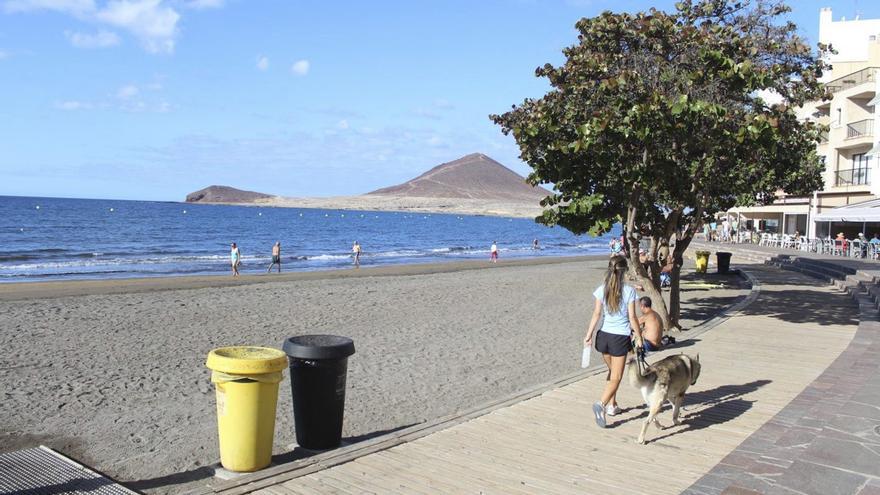
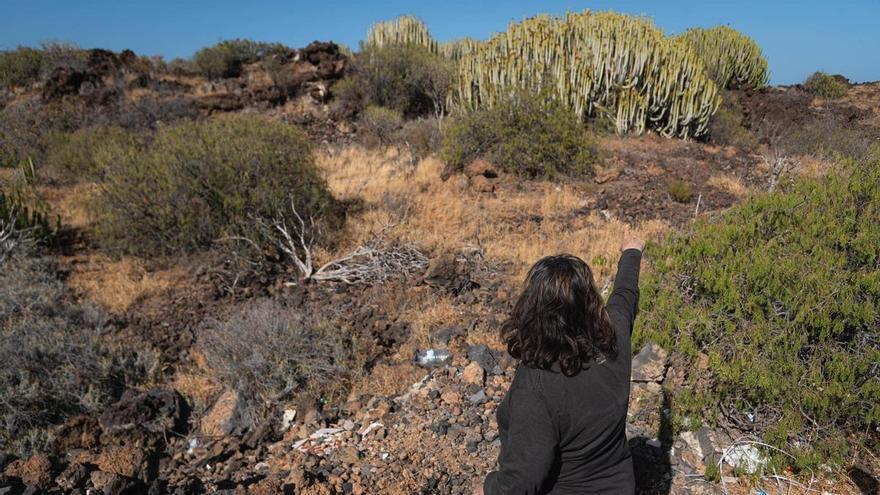
The Special Natural Reserve of Malpaís de Güímar covers an area of 290.3 hectares, nearly three million square metres. The volcanic landscape of the coast is ‘hemmed in’ on all sides: by the motorway, where the volcanic cone of Montaña Grande dominates, by the sea, and by the towns of El Puertito de Güímar and El Socorro. This reserve is home to plant species adapted to arid conditions, high salinity, strong sunlight, and windy environments, which means it holds one of the best cactaceous-tabaidal sequences in Tenerife. Its vegetation includes excellent firewood, tasaigo, cornical, magarza, rosmarinus marinus, and cardoncillo. In terms of fauna, invertebrates are the predominant inhabitants of the area, though the giant lizard can also be observed. Notable bird species include the striped wagtail, blackcap, and capirotada, along with yellow-legged gulls, curlews, and large ringed plovers. From March to October, Cory’s shearwaters choose the Malpaís for nesting. The ecosystem features nine official trails, allowing visitors to enjoy a unique volcanic landscape in Tenerife.