Two old bus stations, in Tacoronte and in Puerto de la Cruz, epitomise the same issue: decades of neglect in vital transport hubs for northern Tenerife. Amid promises of rehabilitation, failed projects, and increasingly visible deterioration, both spaces continue to affect the daily lives of locals and commuters.
The “ghostly” station in Tacoronte
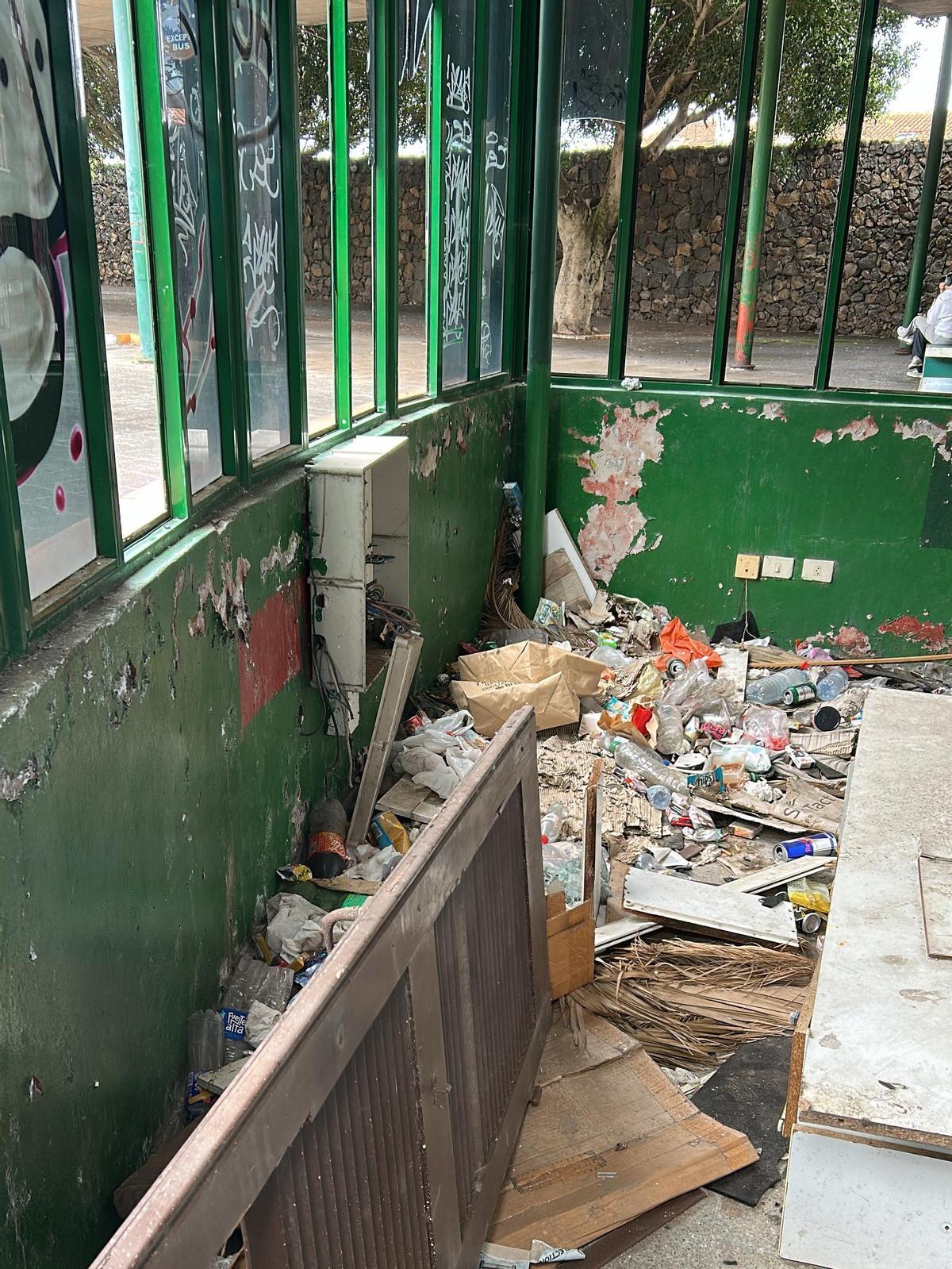
Next to the service road of the TF-5 motorway, near the historic centre of Tacoronte, stands the municipality’s bus station. The terminal, described by locals as “ghostly”, was intended to alleviate traffic congestion, house the local market, and serve as a strategic transport hub. However, the building, apart from being filled with rubbish, displaying visible signs of deterioration, and hosting a few tenants, remains unfinished and abandoned.
Moreover, the building poses a danger to the public. The fencing surrounding the station is rusty, there are windows with broken glass easily accessible, a large amount of rubbish has accumulated inside, and, according to residents, it floods during heavy rain. Outside, its appearance is equally unremarkable. Weeds are starting to overgrow the exterior and its walls have become a canvas for graffiti artists. “It’s embarrassing, Tacoronte does not deserve such an entrance, this has been neglected,” says Carmen, a local woman returning home after getting off one of the buses.
Only two lines pass through the area: 021, heading to Mesa del Mar, and 023, towards the Pris. Titsa, the public company responsible for managing the routes, seems uninterested in utilising the station’s original purpose, as it does not meet minimum safety standards for operations. This is demonstrated by the fact that, just ten metres away, there is a conventional bus shelter that serves three additional lines—30, 102, and 104—connecting the capital and the airport with the north of the island.
Additionally, nearby on the General Road are key lines such as 011, 012, and 101. “It’s a shame, for goodness’ sake… this is half-finished, as if no one has ever bothered to complete it,” expresses Alejandro Martín, a university student who passes through the area daily. “I take the bus a lot and, for example, you see how well-maintained the station in La Laguna is, it’s orderly, and then you arrive here and the contrast is striking. You come to catch a bus in a ghostly, forgotten, and abandoned place,” he concludes before boarding another bus.
From station to parking spaces
The abandonment of the station is not new nor the result of a singular recent decision. In 2022, the municipal council already approved its demolition by a majority to make way for new facilities. This technical project, published on the Transparency Portal of the City Council, anticipated 74 parking spaces for the whole La Estación area and the improvement of pedestrian connections. The mayor at the time, José Daniel Díaz (Nueva Canarias), explained that the works would take 12 months and would be developed in three phases. However, that roadmap also failed to materialise and ended up shelved.
In fact, the municipal plan revived an old urban aspiration to restore the idea of a seven-storey building, five of which would be dedicated to 700 parking spaces and two for multipurpose offices. During the 2007-2011 mandate, with Hermógenes Pérez (Coalición Canaria) as mayor, the project was approved with an initial budget of around €637,000, to be entirely funded by municipal funds. However, the initiative was never implemented and was also forgotten.
Meanwhile, the image is of a property rotting in the heart of the city, with no clear strategy from the authorities for its rehabilitation, demolition, or reuse. “A station cannot be like this, with broken glass, dirt, and no utility. It makes me sad, especially because one sees things being built and then left to decay. Meanwhile, locals continue to endure the sight of deterioration every day,” laments Carmen before leaving with two shopping bags.
Lack of responses
Sources from the current municipal government, formed by the Socialist Party, Coalition Canaria, and the Popular Party, avoided specifying what actions are planned for the site and limited their comments to stating that information will be released when appropriate, once the local government reaches an agreement on this matter. Meanwhile, problems persist in the area, where numerous users are affected without a public and concrete solution presently available.
17 years waiting for a solution for the old station
20 kilometres away in Puerto de la Cruz, another structure, once used as a station, remains in the same state of neglect, overshadowed by one of the most important neuralgic points for transport in Tenerife. Located on Melchor Luz Street, alongside the historic centre, the post office, the emergency medical centre, the health clinic, the current interchange, and several local shops, those passing through the adjacent streets can observe an evidently deteriorated building of 15,000 square metres.
Three different stations
After the eviction of the infrastructure, an 11-year logistical gap occurred. During this time, bus services were temporarily and precariously relocated to Hermanos Fernández Perdigón Avenue, where passengers had to wait outside, exposed to the elements, with no proper service building. Meanwhile, the original structure was left, and still remains, completely abandoned.
“I have seen that station full of people, bustling with life. And now you see it closed, with rubbish, and the usual decay… and you wonder how much longer they will take to actually do something,” says Manuel Hernández, an octogenarian resident of Puerto de la Cruz.
To replace it, on 21 November 2019, and with an investment exceeding two million euros from Cabildo de Tenerife, the new station in the port municipality was officially inaugurated. Located adjacent to the former interchanges, it features ten bays, information offices, and full accessibility for people with reduced mobility.
The start of the works
Now, after a lengthy expropriation and urban management process, the Melchor Luz building will begin demolition in June 2026, once revised financial allocations are approved in municipal plenary and the file can be transferred to the contracting unit.
The project is expected to take 18 months, due to its technical complexity concerning the size of the infrastructure and its central location. “The northern slope of the site needs to be supported, and a significant amount of waste must be managed because of the space’s dimensions,” explains David Hernández, councillor for Sustainable City and first deputy mayor.
For this, the Puerto de la Cruz City Council has allocated one and a half million euros which, combined with just over four million contributed by the Cabildo, results in more than five and a half million euros for the demolition. The goal is to create a large plaza, a auditorium, and multifunctional building, two public buildings, two commercial buildings, and 900 parking spaces distributed across three levels.
For now, “we just need to secure the funding to transfer the file to the contracting unit and, from there, await the publication of the announcement, the submission of companies, the evaluation of offers, and the awarding of the contract. We are working to ensure all this happens before the end of the year so that works can commence before 2027,” the councillor further explains.
In any case, the City Council has contracted the relocation of the items and floats currently inside the station. “This will be the project that will change the municipality the most in the last 40 years,” Hernández continues, “and it will mark a before and after, improving cultural spaces, mobility, and reclaiming a large plaza for the citizens, which is currently not even passable.” Furthermore, “it will not be a project designed exclusively for tourism, but one with a strong cultural and community base, featuring as many green spaces as possible that serve as a point for neighbourhood coexistence and climate refuge in this new city centre,” he adds regarding the intended use of the area.
“This has always been a very lively area, and it still is,” Manuel Hernández admits again, “but that’s precisely why it’s even sadder to see it like this.” “There are shops, there’s movement, there are people passing through all day, and still, the station remains closed and forgotten. One doesn’t need to be visually impaired to see that it has been waiting far too long for a solution. They say it will be fixed next year; let’s see if that’s true; I’m getting old and don’t know if I will see it repaired,” concludes the 81-year-old gentleman.
While the residents of Tacoronte continue to await clarity, those in Puerto de la Cruz are finally beginning to face its demolition. The shared sentiment among residents is the same: too much time lost and too many postponed solutions. Two urban ruins that, beyond their physical state, embody the outstanding debt of administrations to public space.