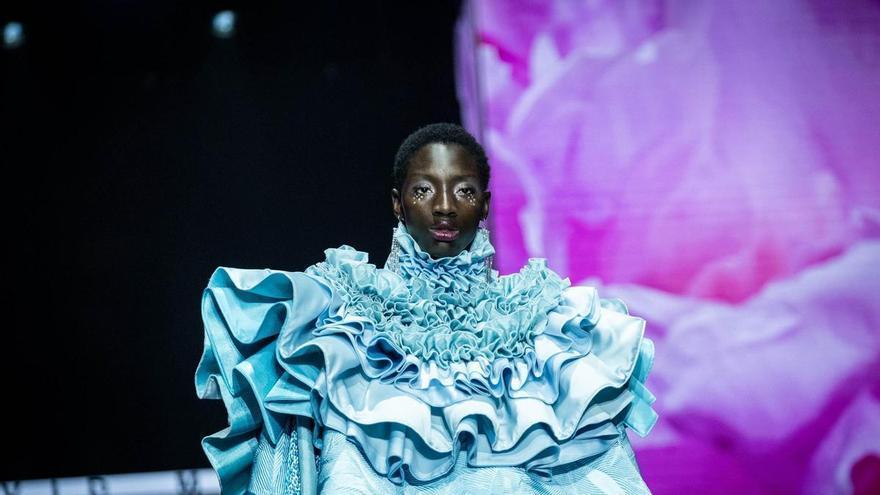
The Tenerife International Fashion Week tonight hosts one of its most significant events with the 15th International Young Designers Contest, taking place at the Santa Cruz de Tenerife Fairgrounds, starting at 21:30. The event, which is already sold out, marks the beginning of the International Fashion Week on the island, featuring runway shows, masterclasses, a barbershop area, and urban trends, attracting a diverse audience. Professionals from the sector will gather alongside the general public, who will enjoy textile talent from both inside and outside the islands.
The Young Designers Contest has established itself as a launchpad for new talents throughout its history. It has enabled creators from within and outside the Archipelago to kick-start their careers in the textile world, validated by this recognition that has increasingly gained an international character over time.
International designers Ni Luh Desy and Ikadek Dode (Indonesia), Johannes Senior Paz (Venezuela), Leonardo Mena (Mexico), alongside Eva Gómez (Vitoria) and three Canary Islanders, Yeremay Hidalgo (Gran Canaria), Yusef González Perdomo (El Hierro), and Noé González de la Rosa (Tenerife), will compete tonight for the first prize of €5,000. They will also vie for a second prize of €3,000 and an award of €2,000 for the most commercial collection, which may coincide with the first or second prize.
Eva Gómez (‘Auralis’)
‘Auralis’ is an island that emerges and disappears throughout the eras. A dozen women from various countries and professions discover, through a forgotten note, that the island and its treasure are no myth. The designer from Vitoria creates an entire imaginary around this idea and uses ancient symbols to shape clothing that accompanies these women on a journey that challenges logic and time. With her proposal, the creator invites the audience to traverse different eras—past, present, and future—allowing her to draw from varied stories across the world to shape her garments, which turn these women into “guardians of mystery.”
Johannes Senior Paz (‘Danzantes’)
Johannes Senior Paz is a Venezuelan designer who, in ‘Danzantes’, invites the audience to travel back to the 18th century in his home country. Venezuela not only inherited a tradition but conceived a rite where the sacred and the profane collide under the Corpus Christi sun. This idea serves as the foundation for his collection, which “arises from the clatter of bells and the surrender of the grotesque to the divine.” Inspired by the Dancing Devils of Venezuela, declared by UNESCO as Intangible Cultural Heritage in 2012, this proposal not only seeks to dress but invokes the power of a faith that blends African, Spanish, and Indigenous roots into a singular heartbeat. He adds that it is “an invitation to witness the movement of that which refuses to die.”
Noé González de la Rosa (‘Archive 00’)
The designer from Tenerife competing in the International Young Designers Contest shapes an entire imaginary around the central idea that the body is the protagonist of his proposal because, as he himself states, “we do not design garments, but forge states.” Dlarosa Studio—under the motto ‘Constructed under the Heat’—is the name of his brand, with which he arrives at this competition at the Fairgrounds to reclaim that the body is not a structure but “transformation and energy.” “Metal is memory; and before form, there is pressure,” states the Tenerife native, emphasising that his collection “is not a beginning” but “is extraction.”
Yeremay Hidalgo (‘Lágrimas de sal’)
‘Lágrimas de sal’ is the title of the collection designed by Gran Canarian Yeremay Hidalgo, inspired by mourning and the vision of pain and repression reflected by Federico García Lorca in his work ‘The House of Bernarda Alba’, set in rural 20th-century Spain. This textile proposal explores how grief emotionally affects individuals within an environment marked by social norms, patriarchy, and family oppression. Consequently, his collection analyses themes such as loss, lack of freedom, and female identity, illustrating how the characters face pain and social pressure. It also represents the process of overcoming grief and its different stages, transforming suffering into strength and personal growth.
Leonardo Mena (‘Mexiconic’)
‘Mexiconic’ is the title of the proposal with which Mexican Leonardo Mena arrives in Tenerife, stating, “it represents my pride in being Mexican.” This is why he incorporates the colours and traditions of his homeland, as well as elements that have made it recognisable worldwide throughout history, such as the Day of the Dead and piñatas. To tell this story, he has drawn inspiration from certain Mexican films where actresses like María Félix and Dolores del Río played significant roles. “I wanted to bring that essence of Mexican glamour from that era into the present,” expresses the creator.
Yusef González Perdomo (‘Melиссae, la voz de las abejas’)
‘Melissae, the Voice of the Bees’ is the collection by this designer from El Hierro, inspired by the black Canary bee and the world of beekeeping in the islands to reflect on the silent labour within the fashion industry. “Just as the bee builds the hive and produces honey through constant and collective effort, fashion is born from anonymous hands that weave, sew, and create in the shadows,” reflects the designer, who creates a collection that draws a parallel between honey collection and the artisanal process of textile creation. Through materials, textures, and contrasts of black and gold, he advocates for the manual, the patient, and the invisible. “Honey is the result. The work, the true essence,” he concludes.
Ni Luh Desy and Ikadek Dode (‘Leal’)
The Indonesian designer brings forth a folk tale from his country, particularly from Bali, to shape the proposal that will be showcased in Tenerife. The protagonist of this collection is the widow Calonarang, who mastered black magic and was feared by all. She had a beautiful daughter, Ratna Manggali, but no man dared to propose to her due to fear of her mother, who felt humiliated and insulted by this affront and unleashed a deadly plague. Through his designs, the Indonesian recounts this story, which ends with the destruction of the sacred widow, not merely interpreted as an evil figure, but as a symbol of a strong woman trapped by her fury.