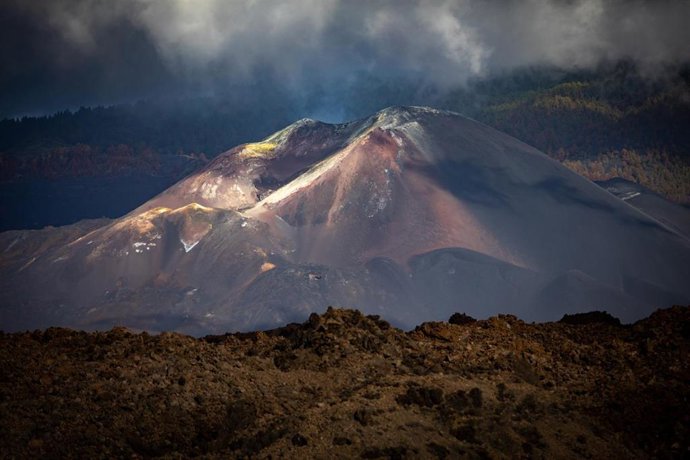
Study Finds No Health Risk from Tajogaite Volcano’s Radon Emissions
A recent study published in the Journal of Hazardous Materials confirms that while the Tajogaite eruption on La Palma increased radon gas levels significantly in nearby areas, the radiation did not pose a severe risk to public health.
Led by Pedro Salazar Carballo from the University of La Laguna’s Medical Physics and Environmental Radioactivity Laboratory, the research involved contributions from colleagues María López Pérez, José Luis Rodríguez Marrero, and María Candelaria Martín Luis from various departments, including the Technological Institute and Renewable Energy (ITER).
Radon, a natural radioactive gas produced by uranium decay in rocks, can accumulate in enclosed spaces and is the second-leading cause of lung cancer worldwide. The study highlighted that the Tajogaite eruption released around 30 million becquerels per square metre daily—160 times the emission rates of other active volcanoes during calm periods and significantly higher than natural soil emissions.
The researchers noted that the eruption’s impact was due to new fractures in the terrain, which facilitated the gas’s rise to the surface. Within the Valle de Aridane, radon concentration decreased with distance from the volcano. In the closest areas, about one in four indoor measurements exceeded the public health guideline of 300 becquerels per cubic metre.
Weather conditions, such as light winds and low thermal inversion layers, also limited radon dispersion, causing it to accumulate near the ground.
Despite the eruption, the estimated ionising radiation dose for local residents over the three-month eruption was only 0.3 millisieverts—well below the risk thresholds. If prolonged exposure occurred, doses near the eruption site could be higher.
Overall, the findings suggest a need for ongoing radon monitoring in volcanic risk assessments to safeguard health and better understand active magmatic systems’ behaviours in relation to local weather conditions.