Just over a month away from marking a year since the first outbreak of phylloxera was detected in the Canary Islands, the infestation remains confined to Tenerife. According to the regional government, the situation is under control despite the emergence of four new cases during 2026.
A Major Threat to Viticulture
Daktulosphaira vitifoliae, the scientific name of the parasite, is regarded as one of the greatest threats to global viticulture. It was first identified in the archipelago on 30 July 2025, in a grape crop in Valle de Guerra, within the municipality of La Laguna. Its discovery ruptured a historical uniqueness; until then, the Canary Islands were the only region in both Spain and Europe free from phylloxera.
Increased Surveillance and Control Measures
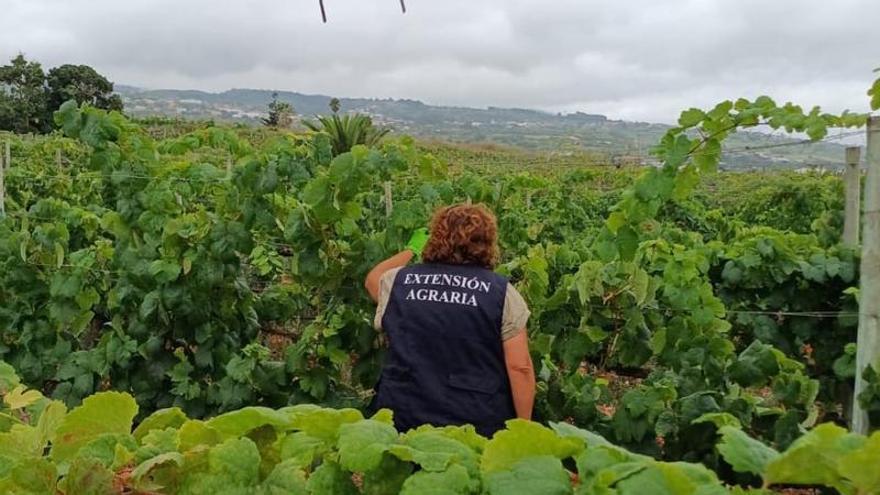
Since the initial discovery, the Agriculture Department of the Canary Government has intensified monitoring, control, and eradication efforts across all the islands. Recent data were discussed this week in a technical follow-up meeting attended by Counsellor Narvay Quintero.
As explained by Quintero, the four new cases detected this year were found between April and May on abandoned farms located within the so-called zero zone, corresponding to the area of the Protected Designation of Origin Tacoronte-Acentejo.
Over 9,600 Inspections Since the Alert
These four new cases add to the 89 cases recorded throughout 2025. According to the department’s successive communications regarding the infestation, the materials affected by the initial outbreaks have already been treated and removed.
In total, since the phytosanitary alert was declared, 9,610 inspections have been conducted, of which 1,831 correspond to 2026. Just in Tenerife, 1,054 inspections have taken place this year.
Inspections have also extended to other islands to rule out the presence of the insect. In 2026, 346 inspections were carried out in Lanzarote, 142 in La Palma, 110 in Gran Canaria, 71 in El Hierro, 67 in Fuerteventura, and 41 in La Gomera.
So far, inspections outside Tenerife have not detected any outbreaks.
Infestation Remains Within Delimited Area
The autonomous government asserts that the situation is controlled since the new cases continue to be located within the area already marked out since the beginning of the crisis.
This situation has opened the door to a possible relaxation of certain phytosanitary measures ahead of the upcoming harvest. The department is already working on regulatory modifications to adapt restrictions to the current state of the infestation.
Quintero has defended the effectiveness of the measures implemented over the past year, stating that actions have been conducted in collaboration with the Regulatory Councils of the Protected Designations of Origin of Canary Wines and the island councils.
From the Initial Focus to Other Areas of Tenerife
The first outbreak was detected in a vineyard in Valle de Guerra, in La Laguna. Subsequently, cases were confirmed in the areas of Tacoronte and La Matanza de Acentejo, as well as at the Agricultural Training School of Tacoronte, in plots designated for the professional training of students located in the Guayonje area.
The department also confirmed the spread of the infestation to the Valley of La Orotava, a region adjacent to Tacoronte-Acentejo and one of the key grape-producing areas in Tenerife.
Nonetheless, the regional government insists that the cases remain within the monitoring framework defined by phytosanitary services and there has been no evidence of expansion to other islands.
A Problem that Spread from Leaves to Soil
The evolution of phylloxera over the past year has been marked by a particularly concerning development for the sector. In December 2025, it was confirmed that the parasite had reached the soil of the affected vineyards.
Until then, detection had primarily occurred in leaves and aerial parts of the plants. However, analyses performed by the national reference laboratory confirmed the presence of the insect in the subsurface.
By that time, 159 soil samples had been taken. Of these, 60 were sent to the national reference laboratory in the province of Lugo, affiliated with the Ministry of Agriculture, and three tested positive.
This finding marked a significant change in the management of the issue, as the presence in roots and soil complicates eradication and raises the risk of the infestation persisting in the affected plots.
Trials with Resistant Rootstocks
In addition to monitoring and eradication efforts, the Government of the Canary Islands has initiated trials with phylloxera-resistant rootstocks. The project aims to analyse the agronomic behaviour of various rootstocks adapted to traditional varieties of the archipelago.
The tests are being conducted on experimental plots of approximately 2,500 square meters, whose owners have voluntarily chosen to participate in the initiative.
These trials are linked to the Protected Designations of Origin of Canary Wines and are taking place in Tenerife, La Palma, La Gomera, Gran Canaria, Lanzarote, and Fuerteventura.
The aim is to study how different rootstocks respond to the soil and climatic conditions of each island, as well as their compatibility with traditional Canary varieties.
A Plague that Transformed European Viticulture
Phylloxera was first described in the United States in 1854 by entomologist Asa Fitch, under the name Pemphigus vitifolii. According to records from the Ministry of Agriculture, the first reports of its presence in Europe date back to 1863, and within a few years, it spread across many vineyard regions.
In mainland Spain, the first outbreaks were detected in Málaga and Girona in the late 19th century. The expansion of the parasite forced infected vineyards to replace their vines with resistant plants, known as American rootstocks.
These plants are varieties of Vitis vinifera grafted onto American roots, which are resistant to phylloxera. This cultivation model ultimately became one of the primary responses to the plague in many production areas.
The situation in the Canary Islands was different, as the archipelago had remained free from the insect until 2025. The emergence of the first outbreak in Tenerife marked a significant turning point for a sector that preserves a unique viticultural heritage, characterised by traditional varieties and vineyards that had not undergone the mass replacement associated with phylloxera.
Concerns in the Wine Sector
The arrival of the parasite was met with concern from the Canary wine sector. The President of the Association of Grapegrowers and Winemakers of the Canary Islands (Avibo) and of the DOP Islas Canarias-Canary Wine, Juan Jesús Méndez, described phylloxera as the greatest threat known to date for the wine industry in the islands.
A year later, the battle against the insect continues to focus on monitoring, containment, and the adaptation of phytosanitary measures. Available data suggests that, for now, its spread remains limited to Tenerife and within the areas controlled by technical services.