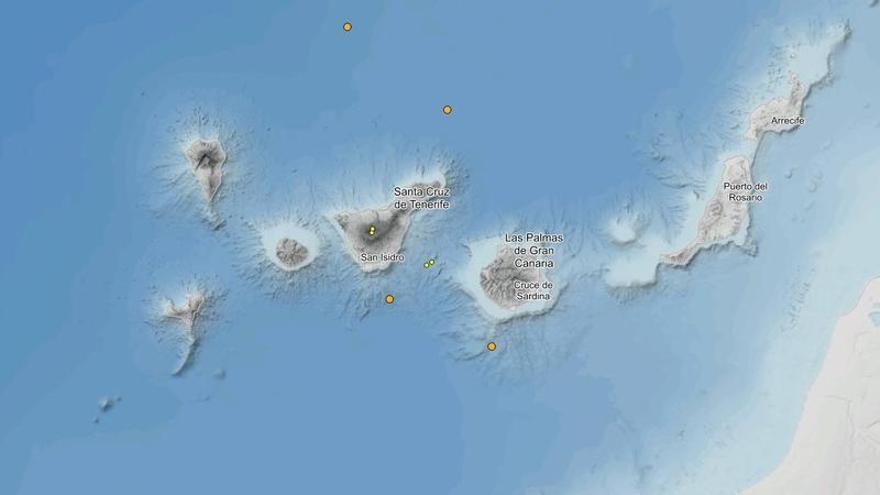
The National Geographic Institute (IGN) has monitored a series of low-intensity seismic movements in the Canary Islands over the past 72 hours. The activity, characterised by tremors imperceptible to the population due to their low magnitude and depth, has been mainly focused in Atlantic waters and specific locations within Tenerife.
The most recent tremor in this series was recorded early on Friday, 19 June 2026, at 00:33, located in the ‘Atlantic-Canaries’ maritime area with a magnitude of 2.5 mbLg at a depth of 34 kilometres.
Increase in Underwater Activity and Magnitude Peaks
The most energetic earthquake recorded during this period occurred on the night of Thursday, 18 June, specifically at 21:13. This movement, also located in oceanic waters, reached a magnitude of 2.7 mbLg and was situated at a depth of 36 kilometres.
Just hours earlier, at 11:01 on the same day, the seismic catalogue detected another earthquake in the Atlantic of 2.6 mbLg, noteworthy for originating at 0 kilometres depth, nearly at the level of the seabed. The remaining underwater events listed have maintained lower magnitudes, fluctuating between 1.6 and 2.4 mbLg.
Seismic Activity in Tenerife’s Interior
Beyond the maritime foci distributed between Gran Canaria and Tenerife, and in the northern part of the archipelago, the seismic map reveals minor tectonic activity within the island of Tenerife:
- Vilaflor de Chasna: On Thursday, 18 June, at 16:57, a tremor of 1.8 mbLg was located in the north of this southern municipality, registering a depth of 24 kilometres.
- La Guancha: Previously, during the night of 16 June, at 20:35, the north of the island recorded another mild movement of 1.5 mbLg at a depth of 12 kilometres.
Experts remind us that these types of low-intensity series fall within the parameters of typical and normalised seismic-volcanic activity in the Canary Islands, serving to confirm the ongoing scientific monitoring to which the archipelago’s subsoil is subjected.