At seven o’clock, when the historic centre still seems to dream of the traditional pilgrimage, the familiar peal of the bells from the parish of Our Lady of Conception breaks the silence, announcing that this is no ordinary Thursday. It is the day when the scent of heather and flowers fills the Villa de La Orotava. The day when the streets, with their characteristic cobblestones, become an ideal canvas for the carpet makers. “Today is the main day of the festivities,” exclaims one of the onlookers early in the morning.
The Origins of the Flower Carpets
The origin of the flower carpets comes from Italy and refers to the term ‘infiorata’, meaning ‘decorated with flowers’. However, in this town, the tradition soon took on a distinctive character. It was Leonor del Castillo, born in 1800 and wife of Antonio de Monteverde, who created the first artistic flower carpet in La Orotava in front of her home at Casa Monteverde. It gained such popularity that this tradition has hardly been interrupted since its inception in 1847. “For us, it is a tradition, a great illusion, a feeling that we have lived with since we were children,” says Luis Hernández, one of the foremen of one of the typical carpets on this day.
Carpets Bringing Families and Friends Together
Over the years, families like that of Luis Hernández have made a custom out of what began two centuries ago. Some have been working on the carpet for 50 years while others join in as novices. This year’s design symbolises themes closely tied to their celebrations, featuring classic embroidery of the traditional costume alongside the beautiful and famous staff of San Isidro, adorned with ribbons and tufts of wheat.
Just a few metres away, where the Orotava Hardware Store usually stands, is the family and friends’ storage area, organised by colours and varieties. This year, they have 120 boxes of flowers. “This day is for sharing,” says Esteban García, another organiser of this carpet, “it’s a day for all the town’s people, our most special festivity.”
Throughout the week, they remove the flowers that bring colour to their creations and burn the heather, which provides its characteristic aroma and the darker shades. This plant is used in four different ways: natural for filling spaces between carpets; stripped, for its green tones; burnt, for brown and toasted areas. The latter is used not only to mask dark spots but also because it is responsible for the scent that permeates the streets of La Orotava.
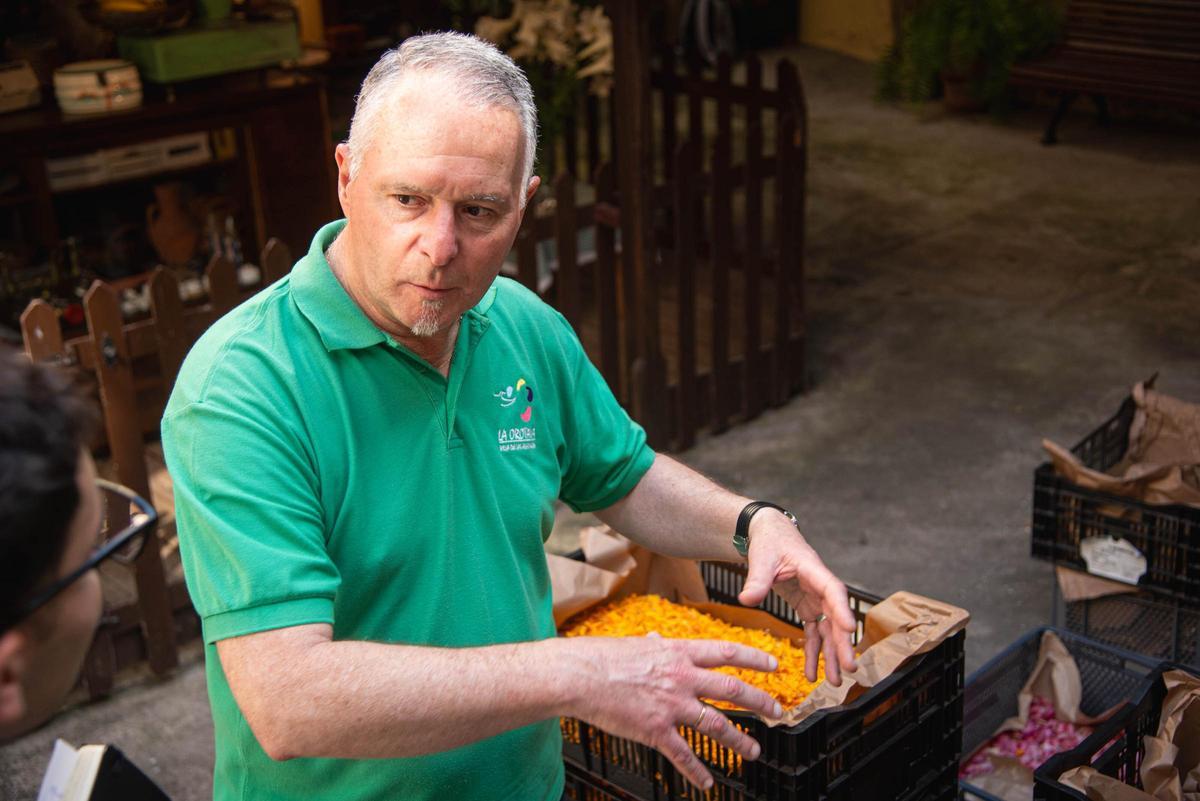
Esteban García explaining the details of his carpet at the Orotava Hardware Store / Arturo Jiménez
“We take pride in seeing the younger generations join in; it’s a task that keeps us busy from eight in the morning until two in the afternoon. Doing it as a family is the most beautiful part,” smiles Esteban García. Once finished, they head to the communal lunch and observe the remaining carpets.
A Historical Journey through the Town Centre
The official route begins at Camino Inocencio García Feo, right in front of the gate of the Church of La Concepción. From there, it descends a few meters down Calle Cólogan to connect with Plaza Patricio García, where it rises again along Calle del Colegio. On this ascent, the route passes by Casa Monteverde before reaching the vicinity of the iconic Casa de los Balcones.
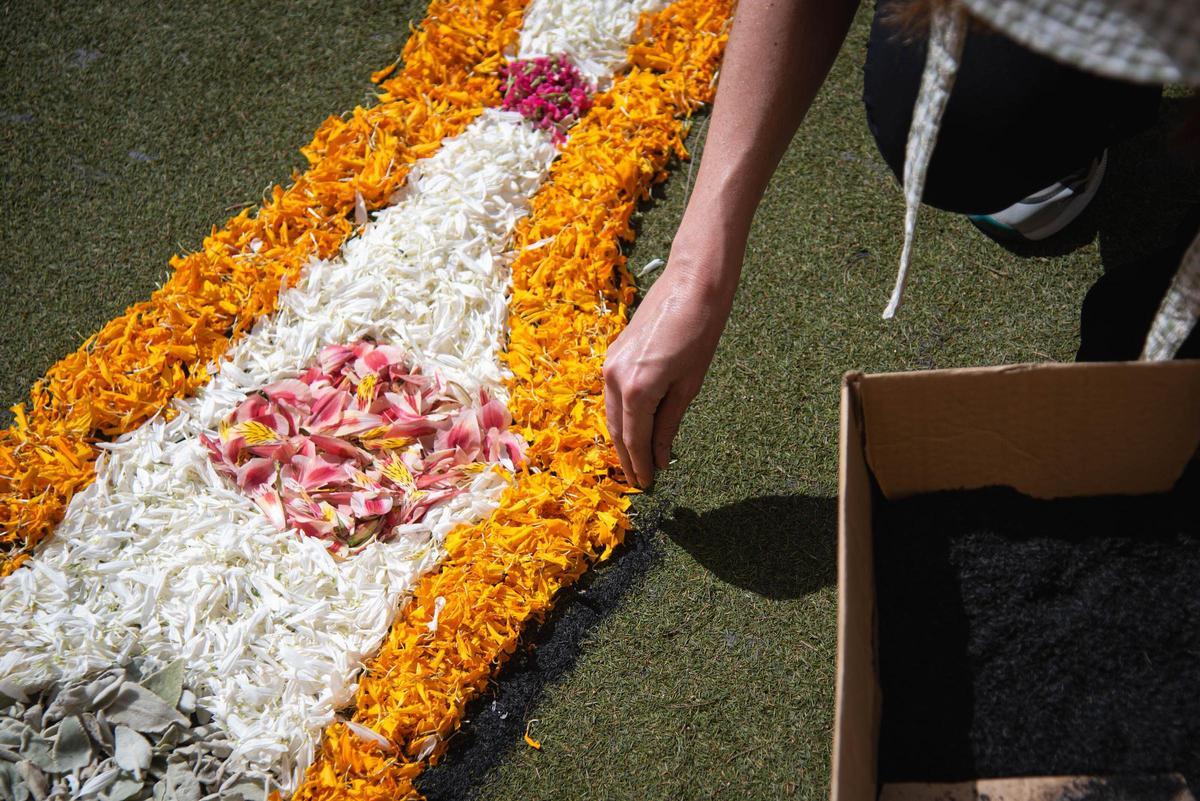
The art of the carpet makers / Arturo Jiménez
From there, the path continues along Calle Carrera del Escultor Estévez until reaching the Town Hall, where the Grand Carpet of volcanic sands can be observed. Along the entire route, amidst the ups and downs of the historic centre, up to 36 groups and families create the carpets. While this is the official route, each visitor is free to deviate and discover the carpets at their own pace.
A Tradition Amongst the Locals
Conchi, a resident of Mayorazgo, agrees that it is a day when the feeling of belonging to the town flourishes, though she confesses that her favourite festivity is the Magicians’ Dance. From the balconies of the Town Hall, she proudly gazes upon the main design of ‘Canarian Paradise’ and the floral carpets surrounding it. “It’s a lovely day; before you know it, it’s afternoon,” she remarks.
As usual each year, she leaves home and makes her way to the centre. After viewing the carpets, she enjoys breakfast at the famous Casa Egon café and then heads back down past the Church of La Concepción to ensure that no corner is left unexplored. Her route mirrors that of many townsfolk. Greeting the carpet makers, Marcos García was also walking with his two children, as this celebration is taught to children from an early age. “We never miss a year,” he explains, seeking the approval of his “little ones.”
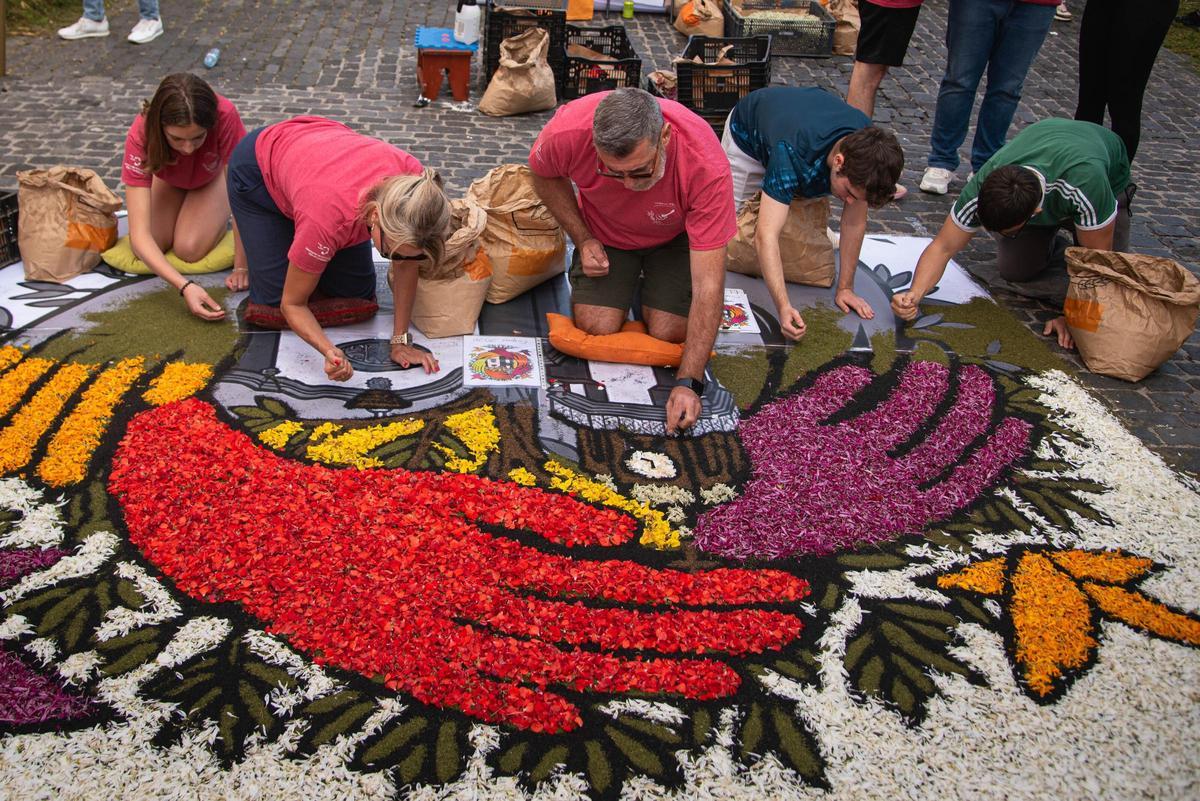
Family and friends gathered around a carpet / Arturo Jiménez
Their first round is in the morning, returning at midday and in the afternoon to witness the procession of the Corpus. For him, it’s an emotional day, and he cannot describe the feelings experienced during the main days of the festivities. “Tell me a day when La Orotava welcomes so many people. There is atmosphere, there is enthusiasm, and above all, there is a deep appreciation for our customs,” he concludes before moving on to observe other carpets.
Since 1980, the Octava of the Corpus Christi of La Orotava has received the distinction of National Tourist Interest Festival, and since 2007, its carpets have been recognised as Cultural Heritage. These two recognitions highlight the immense historical, artistic, and patrimonial value of a unique tradition, passed down through generations and becoming one of the most significant symbols of the municipality that, for one day, draws all eyes.