When Daniel Comín was a child, he didn’t speak his first words as expected. While other children were learning to say “mummy” or “daddy”, he communicated through drawings and scribbles. With pencil and eraser in hand, he filled sheets with shapes and patterns that meant nothing to many, including his mother, Delfina Pérez. However, something within her urged her to treasure those papers like gold. She kept them for years, even as the answers took time to arrive. Unbeknownst to her, she was preserving her son’s first voice.
Today, those same drawings bring life to The Perfect Pattern, Comín’s book that offers a glimpse into the journey of growing up with Autism Spectrum Disorder (ASD). When Comín was just two years old, his mother received the diagnosis. It wasn’t until he turned twelve that he began to speak fluently. Over two decades later, mother and son have managed to uncover the meaning behind those strokes together.
The Perfect Pattern is not merely a book that addresses autism from a scientific perspective. It also includes reports from various professionals who have touched Comín’s life. It is an intimate work that has allowed Comín and Pérez to bridge the communication gap that hindered them for years. “During that time, there was no explanation for what Dani felt,” recalls his mother. Thus, this book has enabled them to reconstruct, drawing by drawing, the first twelve years of a life that could not be expressed in words.
An Art Exhibition Inspired the Author
The work came about almost by chance. Its origin dates back to an art exhibition that Comín and Pérez attended last year for pure enjoyment. At the museum, the artist held a charcoal drawing workshop on the wall. “We participated, and from there I thought, this reminds me of what I did as a child,” he notes.
The following day, driven by a wave of nostalgia, he decided to sort through the drawings his mother had kept. “At that moment, I realised that this vast collection of scribbles, marked by a pattern – hence the title of the work – could be turned into a book,” he explained. And thus he did.
While it is true that at first he felt a bit intimidated revealing this intimate part of his life, he ultimately decided to proceed for one simple reason: to help others. “It was quite challenging, but it is a way of conveying to people that if a child diagnosed with ASD has the necessary support and tools from an early age, they can achieve anything, even write a book,” he pointed out. In those 24 chapters and 188 pages, Comín’s 23 years of development are chronicled.
A Life Structured in Five Blocks
Throughout the publication, Comín opens up his inner world, organising it into five major blocks: childhood before words, perception of the environment, the process of adapting to life, the evolution of his own consciousness, and the way he now understands and inhabits the world.
The book itself is a nod to the communicative process of its author. The illustrations are consistently accompanied by paragraphs that contextualise his own story, but with a particular format: they are written through the gestalts of language processing. This is how Comín learned to express himself, using complete blocks of language rather than isolated words. From the very start, both he and his mother were clear that this feature should manifest in the book. In fact, the initial impression of Comín’s work is that of a poetry collection due to the brevity of the paragraphs.
What Do the Strokes Conceal?
There are numerous anecdotes from his daily life reflected in this story. For instance, one of the chapters is solely dedicated to his perception of noise. “It was something that pierced my body, I couldn’t express that it bothered me and I ran away,” Comín recalls in the book. His mother observed him fleeing from the kitchen or any other room in search of distance. And then, from a place of calm, he would draw. It was his way of turning that chaotic sound into something he could see: “It was how I organised, captured, and immobilised it on paper.” Other drawings, on the other hand, vividly depict the exchange of perspectives that mother and son have now, after so much time. Some even reflect painful stages of his life.
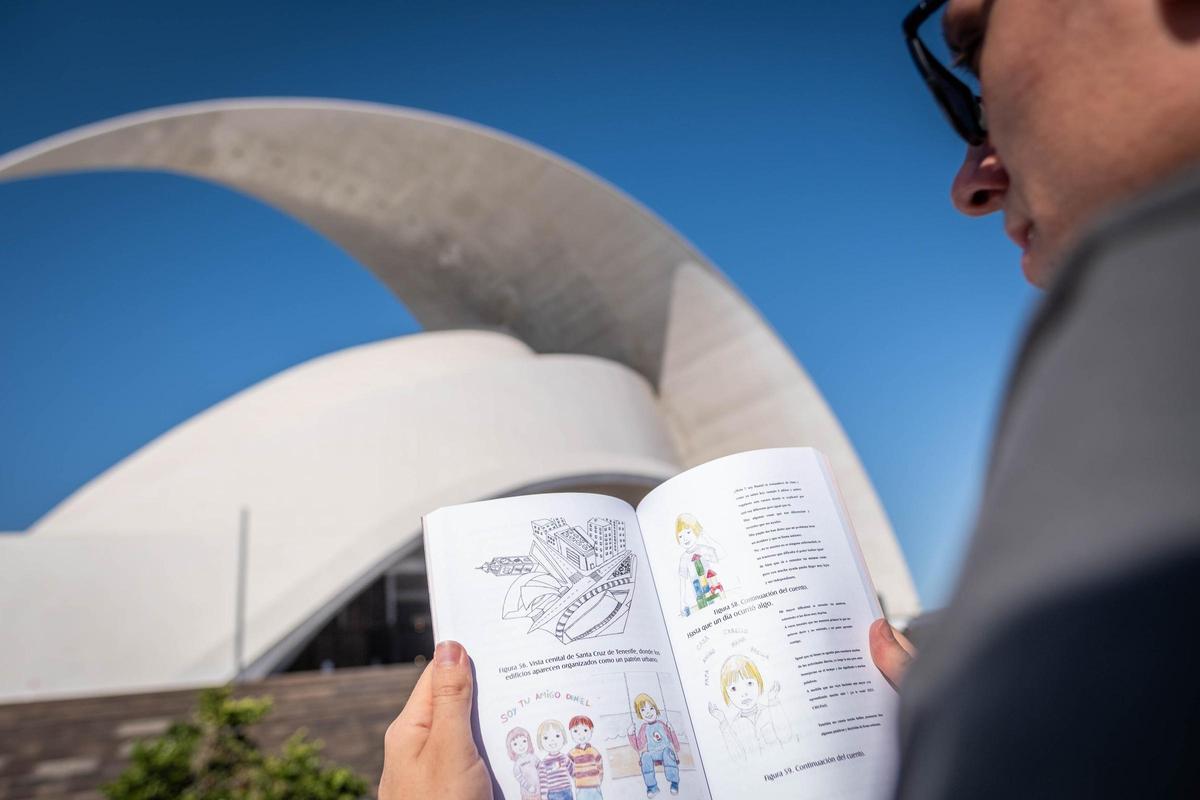
One of the pages from ‘The Perfect Pattern’. / Andrés Gutiérrez
This creative process –which lasted over a year, involving the collection of drawings, their digital refinement, and the writing of the work– has also allowed Comín to rediscover himself through the evaluations of the professionals who accompanied him throughout his life. “He understands many things now and has even told me: it was really difficult and costly for you, I don’t know how you still love me,” Pérez shares. In this way, both have reconnected with a story they lived from different perspectives. For this reason, Comín’s publication is especially dedicated to the person who preserved for years what he could not articulate: his mother.
“Handle with care, it is my voice before words.” With this phrase, the work begins. And, as any good reader, it is wise to heed the warning. For within its pages not only are there drawings: there are also the twelve years of life that mother and son have managed to recover together.