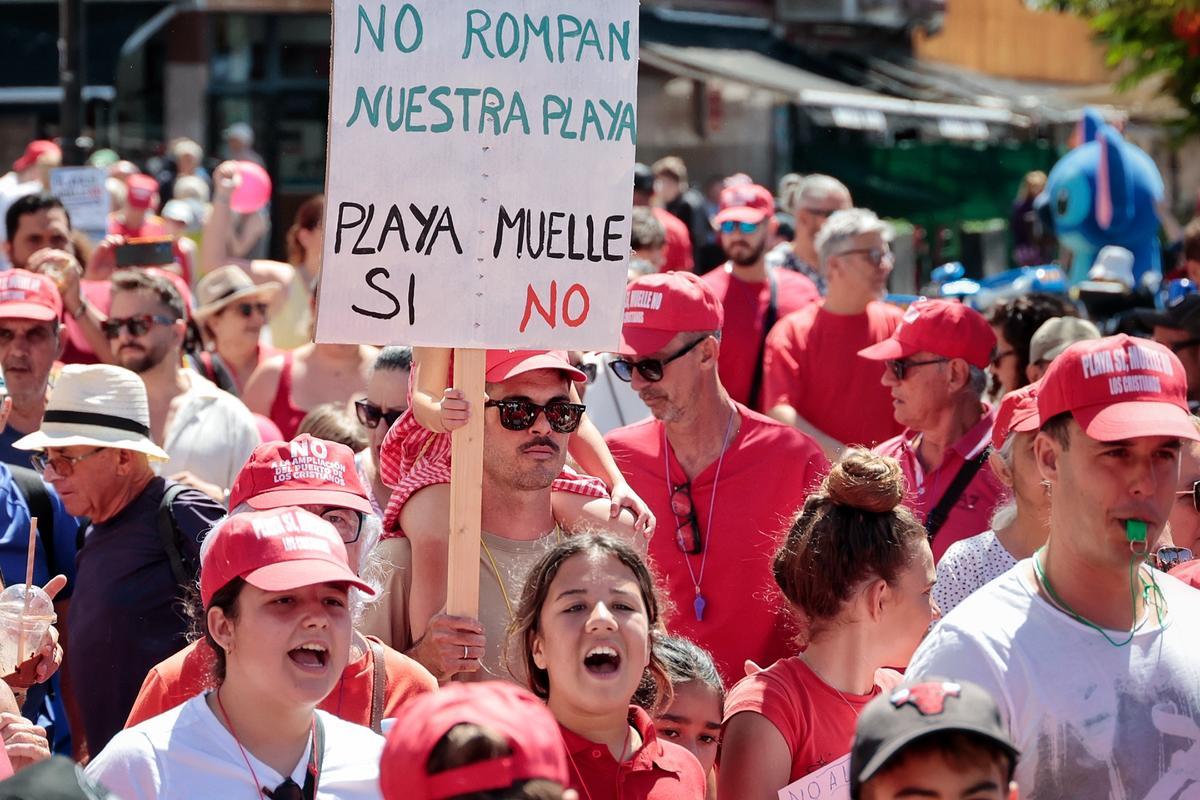
Los Cristianos once again saw its reflection in the bay this Sunday. Three thousand red caps – a symbol of the protest – along with t-shirts, banners, children on shoulders, elderly people walking slowly, and a chant that grew from the sand to the streets: “Beach yes, dock no,” echoed voices with raised fists. In a town accustomed to gazing at the sea, the mobilization called by the Platform for the Defence of Los Cristianos felt like one of those civic days that are unforgettable due to their blend of emotion, territorial belonging, and demands.
Entire families – grandparents, grandchildren, mothers, and fathers – as well as long-time residents, newcomers from the surrounding area, and representatives from all parties in the Arona City Council, shared the march and its message. The organisers insisted that this was not a march against anyone, but in favour of a way of life threatened by port pressure and expansion projects that distance the town from its beach.
Javier Bello, president of the Platform for the Defence of Los Cristianos, encapsulated the sentiment of the mobilisation with one phrase: “We are not just a handful of crazies; it is an entire town that is demanding real, feasible solutions immediately, without additional financial burden.”
Years of Congestion, Noise, Buses and Heavy Lorries
Bello defended that the demand does not stem from a momentary outburst but from years of congestion, noise, queues, goods, buses, and lorries entering and exiting a locality that retains its village memory.
The leader recalled that “the very Rosa Dávila, president of the Cabildo, and Pedro Anatael Meneses, former president of the Port Authority, support the possibility of moving goods to the port of Granadilla.” He stated that this is a reasonable alternative against delayed solutions. “The current proposal for underground streets with tunnels would take 15 years because it is just an idea at present, with no projects in sight,” Bello pointed out.
The manifesto states that the southern region “wants to be respected and heard, and not be peripheral to anyone.”
A Problem of South Tenerife
The support received “from many people in the region” confirms that the issue affects all of southern Tenerife.
The morning felt like a secular pilgrimage. Some reminisced about childhood swims by the old pier, others spoke of the beach as a shared backyard, and some gazed at the port with the feeling that growth was consuming everything. Among the demonstrators, there was consensus that no one disputes the need for improved connections with La Gomera, El Hierro, and La Palma, but not at the cost of turning Los Cristianos into a heavy traffic hub.
The most emotional moment came with the reading of the manifesto by Desiré Valentín Herrera, secretary of the platform. Her speech began by welcoming the “beachgoers” and framed the protest within a context of environmental, social, and economic defence. The text called for the protection of the bay, the search for sustainable solutions for maritime connections, the reduction of port pressure, improved mobility in the south, and increased citizen participation.
A Monstrosity of Parking
The manifesto was unambiguous in its rejections. “We oppose the expansion of Los Cristianos port. We oppose the construction of a dock extending from the old pier. And we oppose the reorganisation of the port, which only aims to place a monstrosity of parking more than 15 meters high.” Desiré Martín then appealed to the identity of a town “that does not want to be marginalized; Los Cristianos needs to be respected and heard – referencing the speech made by President Fernando Clavijo on Canary Islands Day – as the South does not want to be peripheral to anyone.”
Bello explained that the platform has already been in contact with the Port Authority, and the island councils of Tenerife and La Gomera, and will continue to meet with the Government, councils, and town halls. “We will communicate our proposals to all the town halls in southern Tenerife as this issue affects the entire region,” he affirmed.
In Los Cristianos, the beach is not just a postcard: it represents memory, economy, childhood, and future. This is why the cry resonated so deeply: “Beach yes, dock no.”