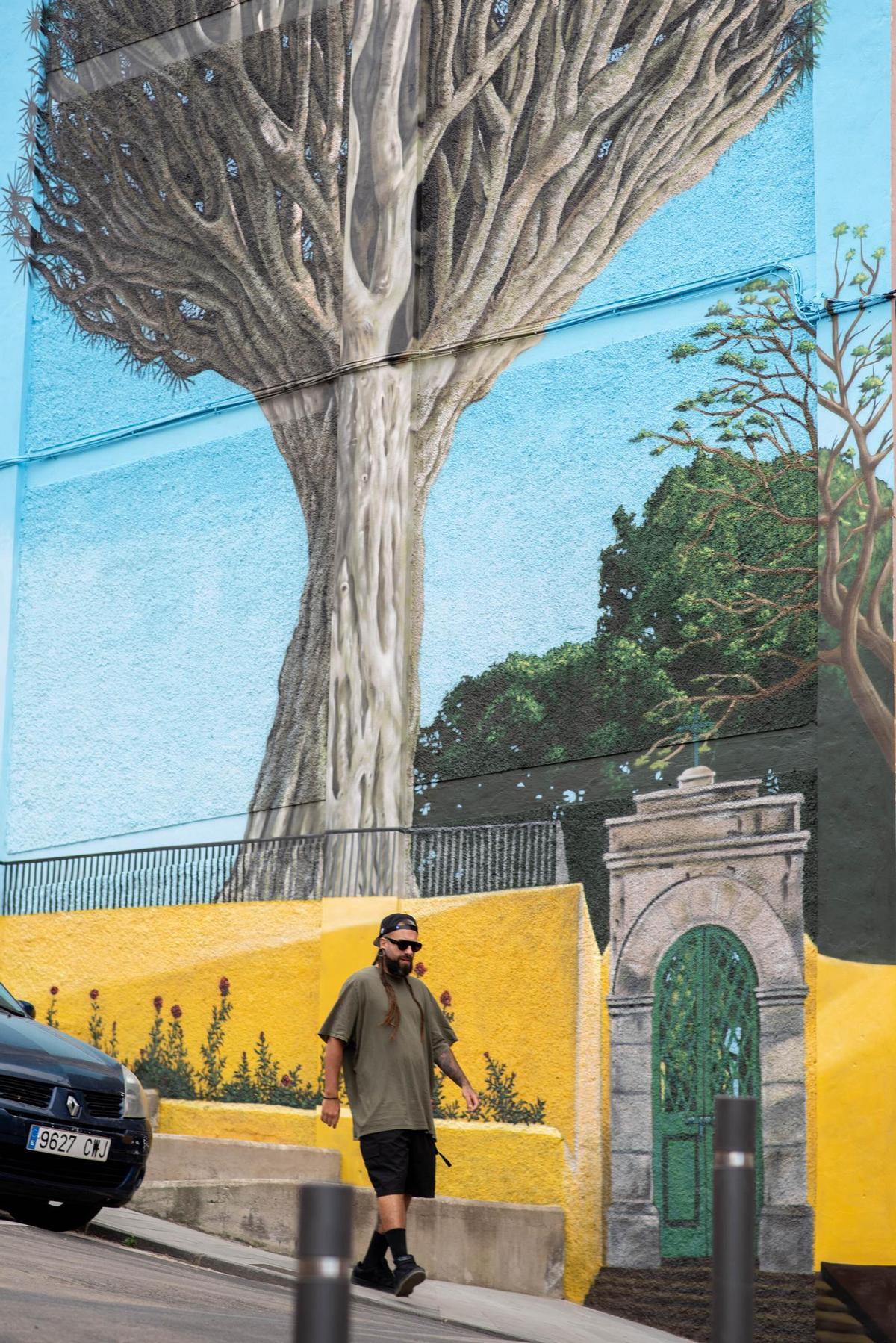
On one of the walls in Los Realejos, a dragon tree has taken root once again. It does not grow in the soil but rather over concrete, transformed into a mural thanks to the strokes of Adán Pérez Farráis. With his spray paints, he brings life back to one of the symbols of the neighbourhood. The tree, which stands 17 metres tall and has more than two centuries of history, was felled by Storm Regina on 4 March 2026, but now it is reborn as urban art, continuing to guard the memories of many generations who grew up in its shadow.
A Life Around the Dragon Tree
“It is a place filled with memories, a meeting point, and where the entire town had a story related to the dragon tree; it was very important.” This is how the muralist summarises the significance of the emblem in the lives of the residents of the San Francisco neighbourhood. A few months after the incident, the Town Hall, at the request of the citizens, contacted the artist, who readily accepted. “They felt it was a gift for them and for the memory of that special dragon. It was beautiful,” says Farráis with a smile.
The project, which lasted just a couple of weeks, required several processes before its inauguration, although some posed quite a challenge. The Realejero muralist always works from a realism perspective. After receiving several model photographs, he began assembling the work. “The main problem we faced,” the artist admits, “was finding a company that could provide a crane instead of a fixed scaffold anchored to the wall.” The challenging location, midway up a slope, and the large dimensions of the wall—almost 12 metres high and nearly 6 metres wide—complicated the possibility of using the first option rather than the second, which would mean he would have to work without seeing the project develop. “In the end, I managed to get the darn crane,” he celebrates.
Now, several locals come by throughout the day to admire the new image of the tree that once held their secrets. “I won’t say my name out of embarrassment; I’m of a certain age, and then they’ll come down on me,” says one of the residents of the San Francisco neighbourhood while observing the mural with much emotion. She herself, with a basket in each hand, recalls the dragon tree as an inseparable part of her life and that of many surrounding families. “I grew up always seeing it there; it was a point of reference, a place you always returned to,” she adds, speaking of what had been a sentimental landmark of the neighbourhood for decades. For her, the design not only beautifies the wall but restores a part of the community’s history and its memories. She also appreciates the artist’s work, thanking him for capturing the essence of that emblem with a realistic and relatable style: “It looks beautiful; it seems to still be watching over the neighbourhood from the wall.”
Almost Two Weeks of Work
The task, however, was not easy. The wall, part of a block of flats, was not in the best condition. Its repair was therefore essential: “I removed the remnants of paint, sanded the entire surface with a wire brush, and touched up some imperfections. In total, it took two or three days to treat the wall, and then the mural painting was completed in a week,” he recalls regarding the project. However, prior to that, he also had to apply a high-quality exterior plastic base coat and a first layer of blue paint for the background.
In total, he used almost 15 litres of that colour alone. “On a flat surface, that amount would yield a lot more, perhaps even triple, but because the wall had a rough, textured finish, it was more complicated. With those reliefs, it is not enough to just apply the paint; you have to work it well, in a circular motion and carefully to cover the entire surface,” explains the muralist.
Artist from a Young Age
For Adán Pérez Farráis, this type of work is much more than a simple commission. Behind every design lies years of learning, practice, and a relationship with painting that began long before he was able to support himself through it. Although he is now one of the most recognised muralists in the region, his story started when he was still a child. “As a child, I would spend hours drawing on sheets of paper and would watch anyone painting a wall with fascination; that was my way of having fun: painting,” he recalls.
This passion grew over the years and drew him towards urban art. He began experimenting with spray paints in secluded areas, learning in a self-taught manner and developing his own technique through trial and error. His first graffiti appeared when he was just 13 years old, and since then, paint cans have been a constant presence in his life. “While my friends went out partying, I saved up to buy paint and went out to draw the next day,” he confesses with a laugh.
From Hobby to Profession
Over time, that hobby turned into a profession. Today, he has been professionally dedicated to muralism for over a decade. Among his most significant works is a mural in honour of Don Antonio Hernández Oliva, a former parish priest of the municipality, located in Realejo Alto. This piece was nominated among the best in May 2025 and, according to Farráis, gained recognition due to “the overwhelming reception” and “the affection it received” from the locals.
Despite all this, he still describes himself as “a lad who likes to paint”. Perhaps because of this, he seeks to break away from the strange sensation of someone who has always had to operate on the margins, much like the image of the rat he has tattooed on himself, to advocate for an artistic form that has not always been well-recognised.