New Exhibitions Open at Círculo de Bellas Artes de Tenerife
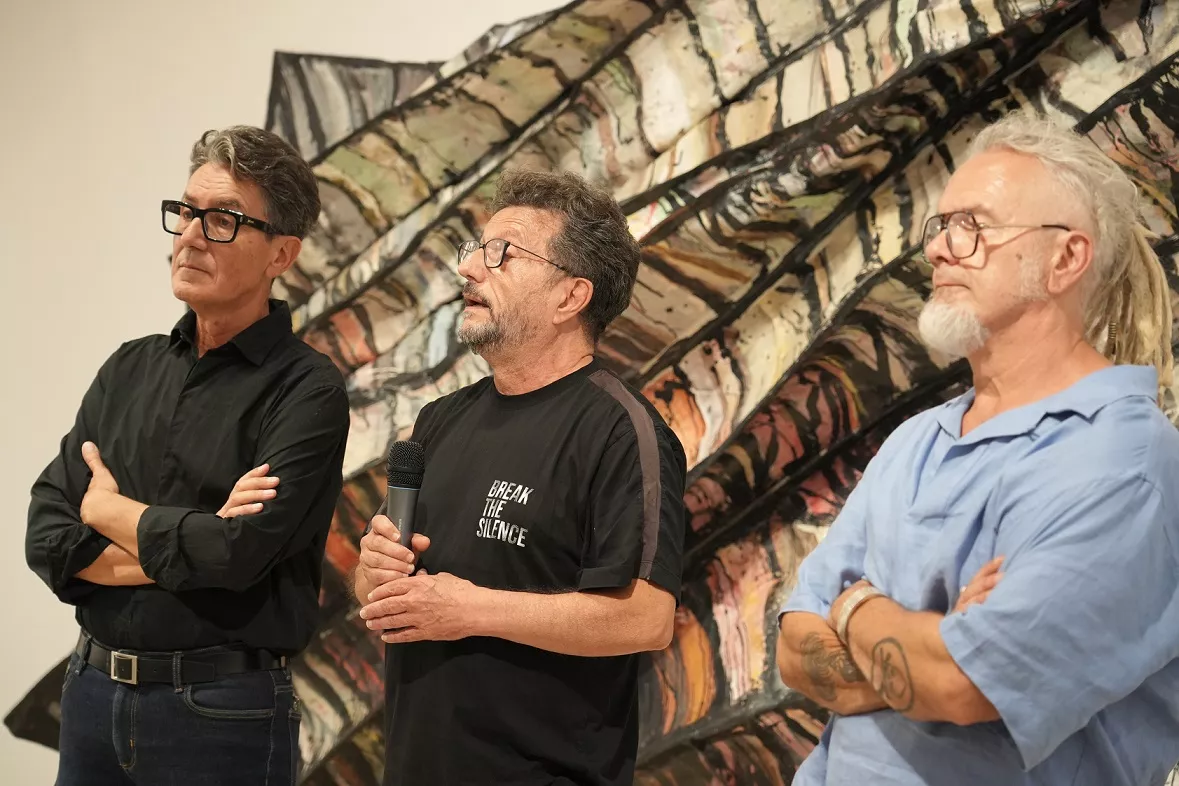
The first installation in the main hall is titled ‘From the Folds of a Map’, while the group exhibition features artistic proposals from Luna Bengoechea, Paco Guillén, Lecuona and Hernández, and Gabriel Roca. Both exhibitions will be open to the public from this Thursday at 19:00 until Wednesday, 5 August.
The Círculo de Bellas Artes de Tenerife, located in Santa Cruz de Tenerife (Calle del Castillo, 43), inaugurated these two new exhibitions on Thursday, 18 June 2026, at 19:00 as part of the centenary celebration for this artistic and cultural institution, which runs from September 2025 to July 2026. As has been customary since last September, one installation features solo work, while the other showcases collective proposals under the series titled Nudos y Enredos (Knots and Entanglements).
Final Event of the Centenary
This is the fifth and final contribution to the central programme celebrating the Círculo’s 100 years of existence. This installation features the plastic artist Santiago Palenzuela, who presents ‘From the Folds of a Map’. The new collective exhibition Nudos y Enredos displays works by artists Luna Bengoechea, Paco Guillén, Lecuona and Hernández, and Gabriel Roca.
Curated by Octavio Zaya, the exhibitions will be open from this Thursday at 19:00 until Wednesday, 5 August 2026, with opening hours from Tuesday to Saturday, 10:00 to 13:00, and 17:00 to 20:00.
The Work of Palenzuela
According to international curator Zaya, Santiago Palenzuela is one of the Tenerife artists who “has most coherently and radically defended the specific power of painting as a language in a time dominated by reproducible images and concept.” He adds, “Since the 1990s, Palenzuela has followed a path focused almost exclusively on oil painting, understood not merely as a technique but as an organic and almost violent process of material construction.”
Zaya explains, “What immediately defines Palenzuela’s work we have known thus far is the thickness of the impasto. In this artist’s hands, paint does not glide softly over the canvas to portray an image; Palenzuela’s paint accumulates, is kneaded, coagulates, and often overflows. The oil is not just a medium but the protagonist of the work. The surfaces of his canvases, which possess an almost sculptural relief, are flooded with impastos, glazes, and brush marks, creating a tactile density.”
“This extreme materiality,” he continues, “is neither decorative nor flashy. It responds to a conception of painting as a living body: Palenzuela has often referred to ‘cadaverous painting,’ an expression that alludes to the ability of the work to continue evolving even after being abandoned by the artist, like an organism that continues its process of decomposition or transformation. For him, painting has a life of its own that transcends the initial will of the painter.”
Recurring Themes
Despite his work passing through various stages, Zaya notes, “Several recurring themes and motifs can be identified: the Atlantic Sea; interiors and mental spaces; portraits, figures and animals.” The exhibition curator believes, “Palenzuela’s greatness lies in his loyalty to painting, understood in its broadest and physical sense: as living matter, capable of growing, overflowing, aging, and transforming. Whether on densely textured canvases or sculpturally formed paper, his work rejects the flat, easily reproducible image, demanding physical presence, proximity, and time from the viewer.”
In his works at the Círculo, Palenzuela introduces “a new line: paper paintings with sculptural configurations. Through folding, manipulating the support, and pictorial accumulation, the paper becomes a volumetric space, expanding the artist’s investigation into painting as matter, space, and transformation,” warns the curator.
Painting and Relief
Zaya asserts that “if in the canvas the paint spills and overflows physically, in these papers, Palenzuela explores how this same material force can inhabit and transform a lighter, more vulnerable support. The result is hybrid works that oscillate between painting and relief, landscapes where the tension between the inherent fragility of the paper and the density of its folds generates new qualities of shadow, volume, and texture. These pieces promise to further expand the vocabulary of an artist who has never accepted the conventional limits between surface and object, between painting and sculpture, figurative and abstract.”
Santiago Palenzuela (Santa Cruz de Tenerife, 1967) has sought a personal art style from the outset, mainly through oil painting. After graduating, he participated in various workshops led by artists such as Jiri Georg Dokupil, Guido Kolistcher, and Mark Dagley. Since 1992, his work has been shown in over sixty solo and group exhibitions in galleries, museums, and art centres across the Canary Islands, Madrid, Segovia, Bratislava, and Prague. Notable solo exhibitions include ‘Cadaverous Painting’ (Casa de los Coroneles, Fuerteventura, 2016, and La Regenta, Las Palmas de Gran Canaria, 2015), ‘Burning Canvas’ (Espacio Canarias, Madrid, 2012), and ‘For Rent’ (Gabinete Literario de Las Palmas de Gran Canaria, 2010, and Sala de Arte Instituto Cabrera Pinto, La Laguna, 2009), among others.
Palenzuela has received several awards and recognitions, including the Painting Prize from Puerto de La Luz and Las Palmas and the Excelens Painting Prize awarded by the Real Academia de San Fernando de Bellas Artes in Santa Cruz de Tenerife. His work is included in the Los Bragales Collection, the Kells Collection, and the College of Architects of Santa Cruz de Tenerife, among other spaces.
Nudos y Enredos
According to Zaya, “Nudos y Enredos is not just a poetic proposal but a declaration of intentions; a conceptual framework that seeks to examine the complexities of the human condition and, more specifically, our reality. By bringing together 20 Canary Island artists from diverse generations, genders, and practices, this programme is not intended as a mere collection of works, but as a field of force where different lines of thought attract, repel, and, above all, knot together.”
The exhibition celebrates the entanglement as a methodology, suggesting that true identity—be it personal, cultural, or territorial—resides precisely in these conflicting and fertile intersections. Moreover, the knot serves as a potent visual and conceptual metaphor, representing both what unites and what confines; what builds connection but can also create conflict and oppression.
In this final installment of the five-part series, “far from seeking forced homogeneity among Luna Bengoechea, Paco Guillén, Lecuona and Hernández, and Gabriel Roca, the exhibition brings together artistic practices that explore the invisible links structuring our experience of the world. The knots here appear as systems of connection, dependence, resistance, or conflict; the entanglements, as that which challenges simple categories and reveals the complexity of natural, social, and cultural processes,” the curator continues.
Artistic Diversity
In conclusion, Nudos y Enredos 5/5 “does not attempt to untangle what is inherently complex. On the contrary, far from presenting a single, simplified view of Canary Island art, the five installments we have offered throughout this programme advocate for its intrinsic richness and diversity. This time, Bengoechea, Guillén, Lecuona and Hernández, and Roca, each from their own perspective, demonstrate that the knots—geographical, social, emotional, and material—are what truly weave the fabric of contemporary experience,” states Zaya.