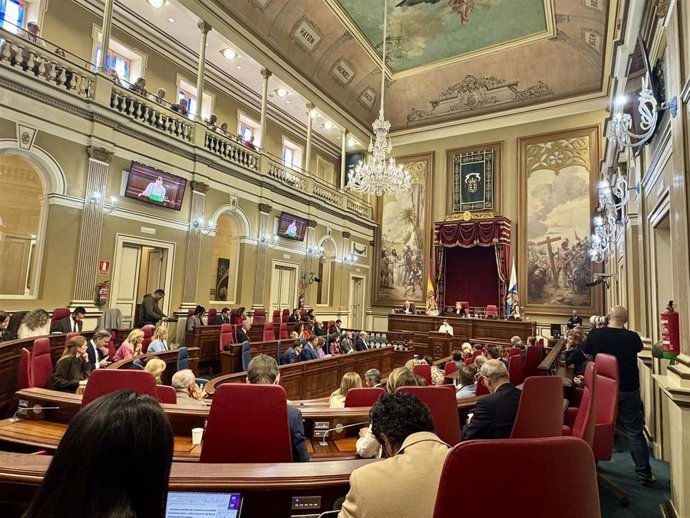

– PARLAMENTO DE CANARIAS – Archivo
SANTA CRUZ DE TENERIFE, 10 Jun. (EUROPA PRESS) –
On Wednesday, the Plenary of the Parliament of the Canary Islands approved the reform of the Cabildos law, with votes in favour from PSOE, CC, PP, NC-bc, ASG, and AHI, while Vox opposed the measure. This reform was proposed by local corporations to adapt to the new Statute of Autonomy established in 2026.
RECOGNITION FOR CABILDOS AS ISLAND ENGINES
The spokesperson for the Mixed Group, Raúl Acosta (AHI), remarked on the “recognition” of cabildos as the “engines of the island,” granting them permission to construct housing or student residences beyond their immediate boundaries.
Acosta highlighted the “maturity” to understand that development in the Canary Islands is “from the island upwards”. He asserted that cabildos are “not just another institution,” but the ones that “look the citizen in the eye,” now formalised through this legislation.
BUDGETARY CONCERNS
However, he unsuccessfully sought an amendment to reduce spending in Chapter 1, as larger and smaller cabildos have “different needs,” warning against a potential “amalgamation” of roles that may hinder effective management.
Vox’s deputy spokesperson, Paula Jover, acknowledged the “uniqueness” of cabildos within the administrative framework of the islands as an “essential intermediary entity” between municipalities and the autonomous community. She stated that this reform goes “beyond” the mandate of the Statute’s reform.
Jover argued that the reform “strengthens” island power while “weakening” the autonomous community, as her party advocates for “recentralisation of competencies” rather than further decentralisation. “Voting in favour of this law would be incoherent,” she added.
Additionally, she lamented the missed opportunity to reduce bureaucracy and create “efficient, transparent cabildos that serve citizens rather than the party.” Jover also criticized the “indeterminate political spending” that permits the creation of island vice-ministries, two new funds, and discretionary appointments by the president, stating, “We do not need more roles or administration. We need better services, lower taxation, and less administration.”
CALL FOR ADMINISTRATIVE SIMPLIFICATION
Luz Reverón, spokesperson for the Popular Group, noted that amending the law was “necessary,” emphasising “administrative simplification” against “unnecessary bureaucracy.” She urged avoiding “uncertainty” and “contradictory interpretations,” particularly concerning Article 88.
Reverón expressed that the law should provide “clear answers” to ensure that the dual nature of cabildos as local institutions and entities of the autonomous community does not create “permanent doubts over function execution or applicable legal frameworks.”
“There can be no grey areas; there should not be different interpretations depending on the cabildos or the national appointee involved,” she indicated.
CURBELO CALLS FOR MORE COMPETENCIES FOR PERIPHERAL ISLANDS
ASG spokesperson, Casimiro Curbelo, described cabildos as “singular, efficient, and citizen-friendly administrations” with a “two-faced nature.” He demanded even “greater decentralisation” of powers to counterbalance the political and economic dominance of Tenerife and Gran Canaria.
He insisted on “more competencies” for peripheral islands and specific taxation measures to prevent, especially the ‘green islands,’ from remaining “impoverished.”
Luis Campos, spokesperson for NC-bc, expressed hope that this law would facilitate the development of the Statute of Autonomy and “advance the construction of the nation,” advocating for a “unique legal framework.” He emphasized that amid “recentralisations and globalisations,” the approval of this law holds “political significance.” “Today, we create a nation,” he commented.
Socorro Beato of the Nationalist Group praised the cabildos as the “most valuable and unique” institutions in the governance of the islands, stating they need to be adapted to the new Statute of Autonomy and that this new law “clarifies competencies.”
Beato valued the “consensus” of the Chamber in promoting this reform and agreed with NC-bc that the Canary Islands “believe in their institutions” and “update their self-government.”
Nayra Alemán (PSOE) recognized the consensus of Fecai in advocating for the law reform and the “responsibility” of her group, even while in opposition, assuring that this reform “modernises” cabildos, endowing them with better tools and clarifying their competencies.
“Most groups have understood that this is not a law for confrontation; it is legislation to strengthen island self-governance,” she asserted, criticising Vox for their lack of understanding of cabildos. “I’m pleased because it means they have not engaged in the debate, and I hope they stay out for a long time,” she remarked.
In this vein, she indicated that a “step” has been taken towards “building a more coordinated, effective Canary Islands with institutions better prepared to serve the citizens.”