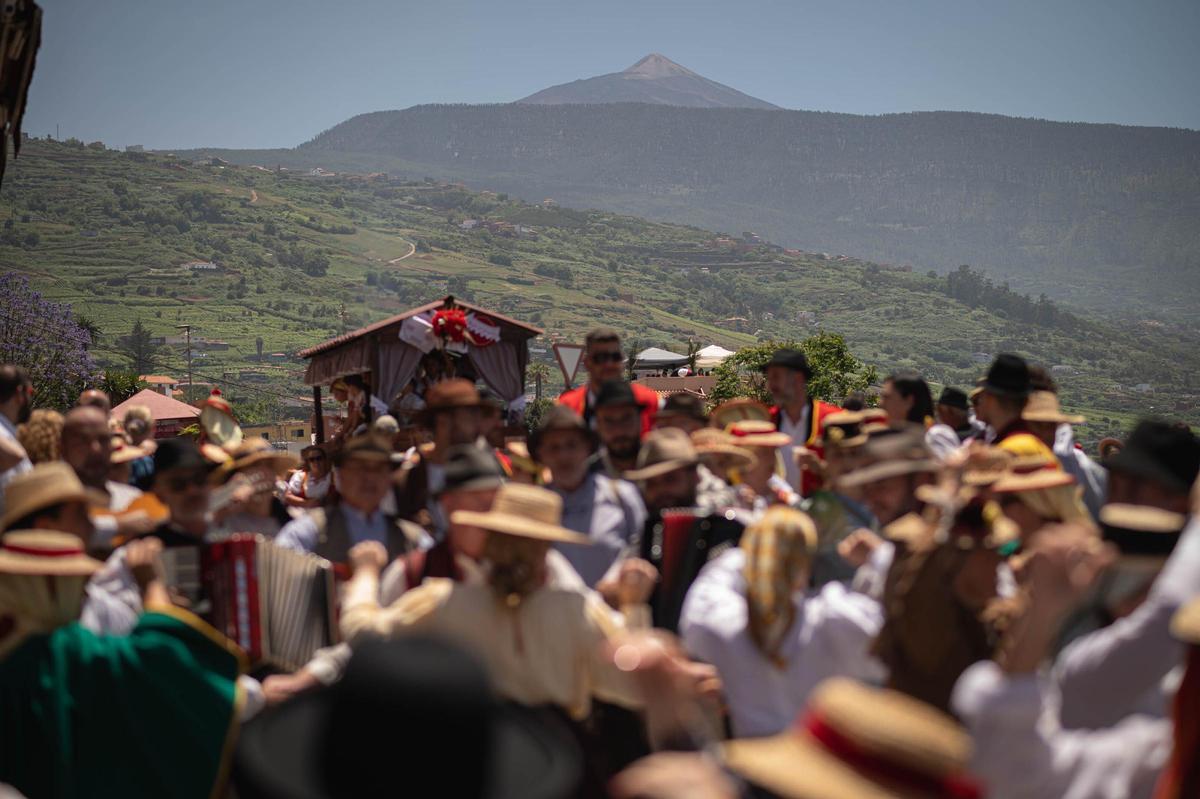
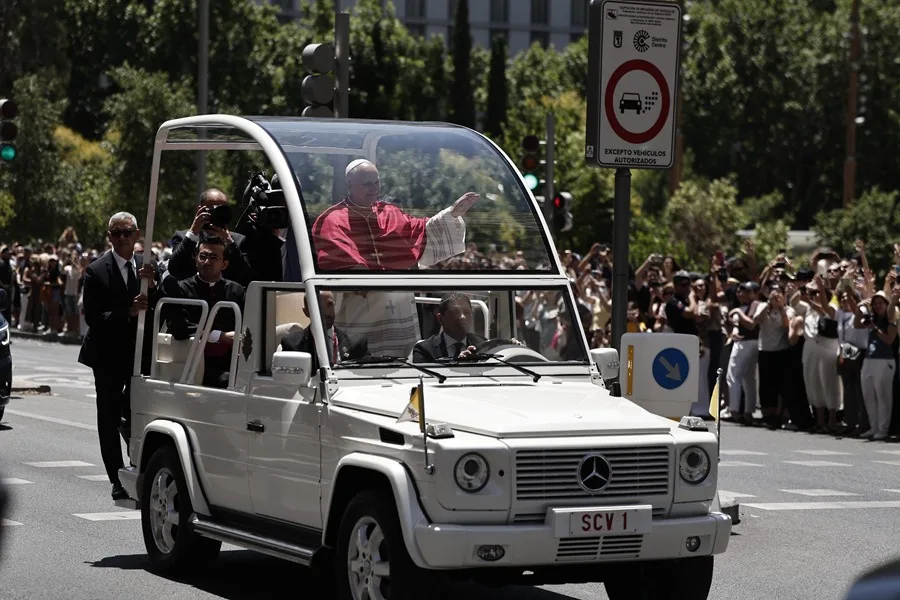
It seems like just another day in mid-June. The school year is coming to an end. Young people, who have been studying for months in municipal libraries to prepare for university entrance exams, are already dressed in swimwear and sunglasses. It smells of summer, the sea, and freshly opened sun cream. While all eyes are focused on the visit of His Holiness León XIV and the start of the World Cup, in the Valley of La Orotava, adorned at this time with flags, flowers, and decorated balconies, the focus is on the Grand Carpet of Corpus Christi, which has already been unveiled from the tent that hid it from the sun.
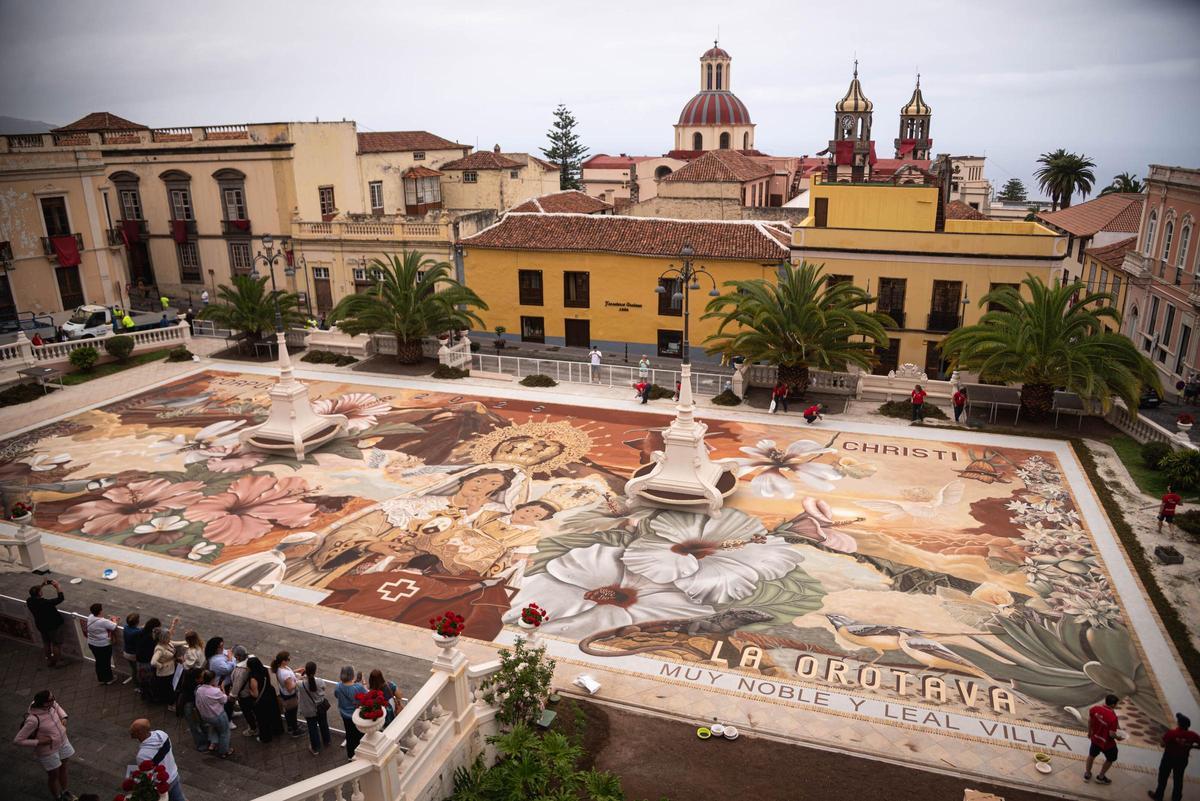
The Grand Carpet of La Orotava / Arturo Jiménez
During these weeks of patron saint festivities, the township is at its peak glory. “I’m over 80 years old and I can’t recall a single year of my life, apart from during the pandemic, in which I haven’t enjoyed my festivals,” says María del Carmen, a long-time resident. “I’m not up for too much excitement anymore,” admits the lady, “but no one can take away my joy of seeing the carpet at the Town Hall.” This love for local traditions has been passed down to her two granddaughters, as if she were a witness to it all. “You can’t imagine how much they love to party… they never miss a Dance of the Magicians. They even went to see the Sabandeños on Monday, to enjoy the music, and they still have the wine tasting and the Romería left. Oh, to be young again!,” she smiles.
The Best Views of La Orotava
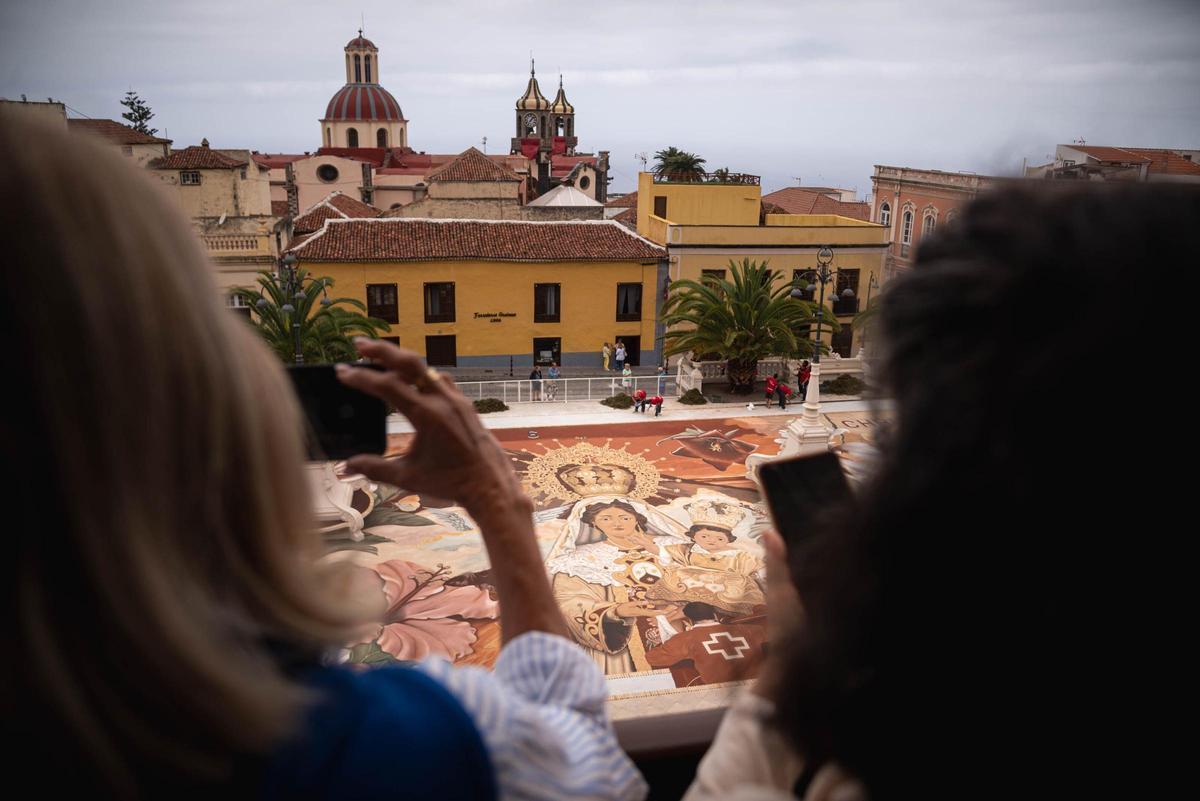
The doors of the neoclassical Town Hall will remain open for the curious. Those who visit can ascend to the first floor and gaze from the balconies that, since 1869, offer a perfect view overlooking the Church of La Concepción. From there, the views over the central carpet in the Town Hall square “are unbeatable.” This is how Antonio Manuel, another local resident from the upper part of the village, described it.
“From here, you understand why these days are so special for the people of the Valley; it is a masterpiece,” he asserts. Antonio Manuel, who is now retired after a lifetime in teaching, stepped out for a stroll to “take advantage of the cool morning air and see the atmosphere around the finished carpet.” “There’s much tradition here, but also a lot of hard work. Young people perhaps don’t perceive it like before, but the skill of the carpet makers is spectacular,” he remarks while looking over the square from the Town Hall balcony.
Artearena, the Master Carpet Makers
The beauty of the day lies not only in the final result but also in everything that precedes it. After more than two months, the 23 volunteers from Artearena, the group responsible for designing and creating the carpet, have successfully unveiled the 900 square metres of carpet made from volcanic sands from the national park. Remarkably, the carpet has withstood the light drizzle through the night, which slightly dampened the design, according to locals.
This year, the carpet transforms the historic centre into a symbolic journey between heaven, earth, and the identity of the islands. Under the title ‘Canarian Paradise’, the work blends religious tradition with elements of the archipelago, such as Teide, the sea of clouds, and various species of native fauna and flora. Additionally, it incorporates small nods to current events, such as the presence of the Red Cross, linked to the migration realities of the archipelago, and the figure of the current pontiff, referencing his recent visits to Tenerife and Gran Canaria. “They even included the Pope, how nice. They should have brought him here to see it,” says a couple who came for the first time.
Astonishment and Admiration Among Attendees
On the morning of the presentation, only words of astonishment and admiration can be heard. “Look at all the people who came to see the carpet,” one onlooker exclaims. “It’s beautiful, look at the details,” say others. The scene, just hours after the shops opened, is remarkable. The steps connecting the design to the Town Hall are packed with people seeking a photograph, a panoramic view, or simply a few moments to admire the work. Meanwhile, municipal services are already preparing and decorating the streets for the big day. “Let’s go, Juan, we’ll see it tomorrow; I’m running late,” a lady tells her husband, who wanted to go up to the balcony.
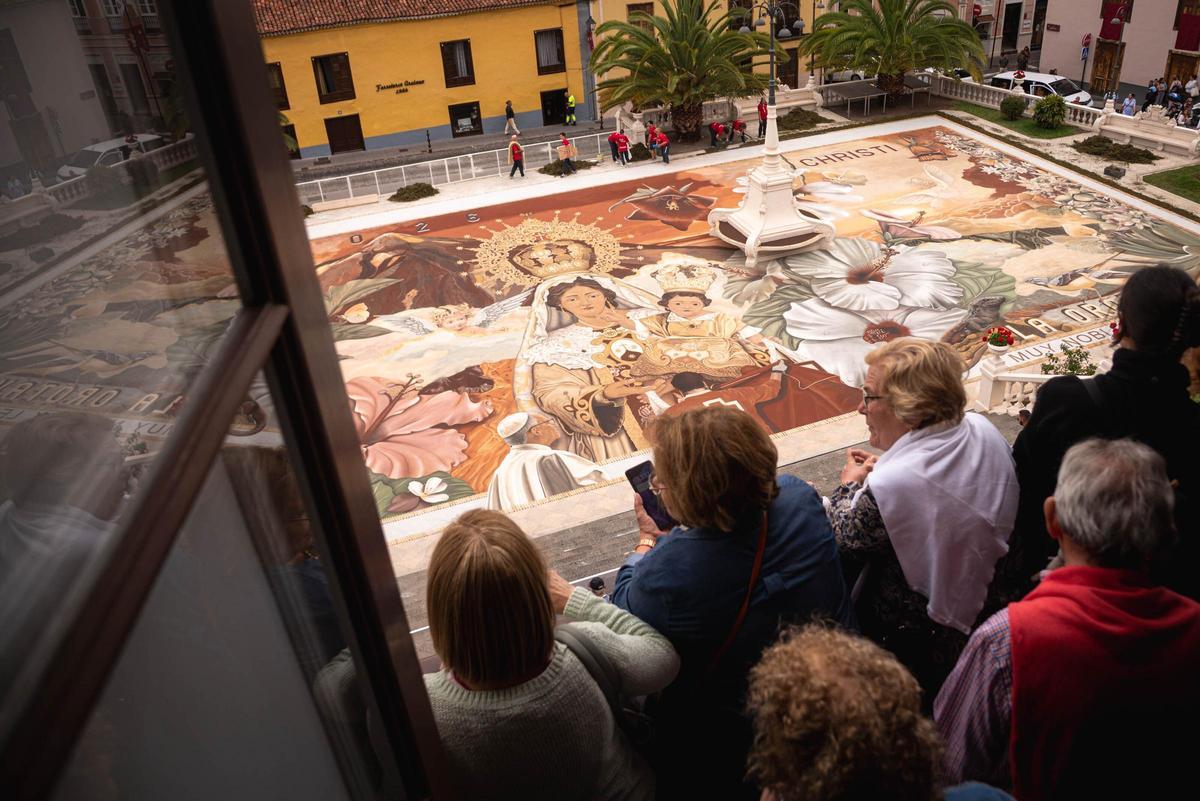
People crowded to see the carpet from the balcony of the Town Hall / Arturo Jiménez
“Every year I say it won’t surprise me, and every year I’m wrong,” comments a woman who has come from Santa Úrsula while pointing out some details in the design. This admiration is echoed among the younger crowd. “I’ve been here before, but I’ve never stopped to appreciate everything that’s in it,” says Alejandro, a student who just finished his A-levels. “When you see the animals, the shadows, the faces… you realise the effort that went into it; it’s an unbelievable amount of work,” he adds.
A few metres away, another visitor listens to the conversation and nods. “The beauty is that it lasts such a short time. It’s a shame, but that’s precisely why people appreciate it so much,” she comments. Indeed, this is an art destined to disappear that nevertheless attracts all kinds of audiences. In a month marked by significant events both inside and outside of the Canary Islands, La Orotava again demonstrates that, if only for a day, all attention is focused on 900 square metres of volcanic sand.