
– GOVERNMENT OF THE CANARY ISLANDS
SANTA CRUZ DE TENERIFE 10 Jun. (EUROPA PRESS) –
The Government of the Canary Islands’ School Fruit and Vegetable Consumption Plan has distributed a total of 182,517.93 kilograms of produce this school year to 65,050 primary school students across 343 public centres in the Canary Islands. This programme is funded by the European Union and implemented in the islands by the Government of the Canary Islands through the Canarian Institute of Agricultural Quality (ICCA).
The programme aims to promote healthy eating habits from childhood and help prevent obesity and other related diseases through the consumption of fresh, seasonal agricultural products.
Since March, participating students have received bananas, papayas, oranges, melons, watermelons, apples, and cherry tomatoes over ten consecutive weeks.
In total, the initiative has enabled the distribution of 15 servings of fruits and vegetables per student this year, equating to approximately 2.8 kilograms per participant in this programme aimed at children aged three to twelve, according to a statement from the Executive.
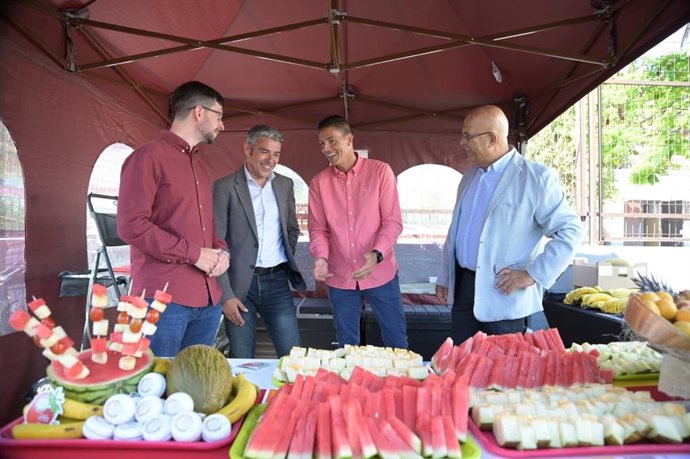
The Minister of Agriculture, Livestock, Fisheries, and Food Sovereignty of the Government of the Canary Islands, Narvay Quintero, visited CEIP Isabel La Católica, one of the participating schools, on Wednesday, accompanied by the director of the ICCA, Luis Arráez Guadalupe; the territorial director of Education for the province of Santa Cruz de Tenerife, Adrián Delgado; the school’s head, Miguel Ángel Navarro; and the project’s secretary and coordinator, María Salas.
During the visit, Quintero emphasised that the School Fruit and Vegetable Consumption Plan “has established itself as a reference initiative to promote healthy lifestyles based on local products and educate Canary Islands students on the value of fresh, seasonal agricultural production.”
The minister highlighted that these foods “are a fundamental tool for encouraging a balanced diet from an early age” and explained that the programme is part of the Government of the Canary Islands’ actions aimed at promoting healthy eating, enhancing food education, and supporting the primary sector in the islands through other initiatives such as Eco-Canteens of the Canary Islands and ‘Gofio, Olympic Breakfast.’
With these projects, he said, “we aim to support the agricultural and livestock sectors of the islands, contribute to the wellbeing of Canary Islands students, and raise awareness among children and young people, consumers of today and the future, about the importance of choosing local products.”
Meanwhile, ICCA director Luis Arráez Guadalupe stated that “this plan enhances students’ understanding of issues such as local food chains, organic farming, sustainable production, and the fight against food waste, aiming to establish responsible and health-promoting consumption habits, with a strong emphasis on local produce.”
Arráez also thanked “the involvement of teaching and non-teaching staff at the schools, who make the distribution of these products possible and help students incorporate these lessons in a practical and engaging way.”
In this regard, the school’s head, Miguel Ángel Navarro Baquero, described the project as “a very beautiful and interesting initiative, well-received by both students and teachers.” He added that aspects related to healthy eating are discussed in the classroom, allowing students to delve deeper into the importance of local production.
“This understanding has been well conveyed to the students, and we consider it essential for them to grow into adults who consume and can distinguish and appreciate fresh, seasonal products,” he emphasised.
OVER FIFTEEN YEARS OF PROMOTING HEALTHY HABITS
The School Fruit and Vegetable Consumption Programme was launched in the Canary Islands in 2009, with the participation of 41 educational centres and approximately 11,700 students.
Since then, under the oversight of the state-owned GMR Canarias, it has experienced continuous growth, reaching 343 centres and over 65,000 students throughout the archipelago by the 2025-2026 school year.
In addition to food distribution, the project includes various accompanying measures and educational activities with a playful component, aimed at encouraging the participation of the entire educational community.
EDUCATIONAL MATERIALS
Within this programme, educational resources and materials are available on the Canary Islands Fruit and Vegetable Plan website. Activities are conducted both inside and outside the classroom, focusing on the characteristics of organic production, the importance of consuming fruits and vegetables, particularly from local sources, and the benefits of sport and physical activity for maintaining good health.
Notable initiatives include ‘La frutiguagua’ and ‘La frutiplaza,’ designed to engage families and help consolidate knowledge gained in classrooms through outreach activities, inflatable structures, and play spaces where fruits and vegetables take centre stage, complemented by tastings and recipe-making workshops using these products.
Another highlighted initiative is ‘Fruta Divertida,’ a school competition aimed at promoting the benefits of fruits as a fundamental part of a healthy diet within the educational community.
In this activity, students, with the help of their families or teachers, create imaginative photographic compositions using pieces of fruit.
The competition album, available on the programme’s website, already features over 17,000 images, making this action one of the most participatory school initiatives in the Canary Islands and one of the most prominent nationally.