In front of a full Plaza de Cibeles, extending down the Calle de Alcalá and along the Recoletos-Castellana axis, His Holiness celebrated the first of four mass gatherings during his visit to our country.
Image: Marcos Nogales
On the solemnity of the Most Holy Body and Blood of Christ, Pope Leon XIV presided over the Holy Mass this morning in Plaza de Cibeles, the central event of his apostolic journey to Madrid, which was followed by a procession and the Eucharistic blessing with the Blessed Sacrament, witnessed by over 1.5 million people.
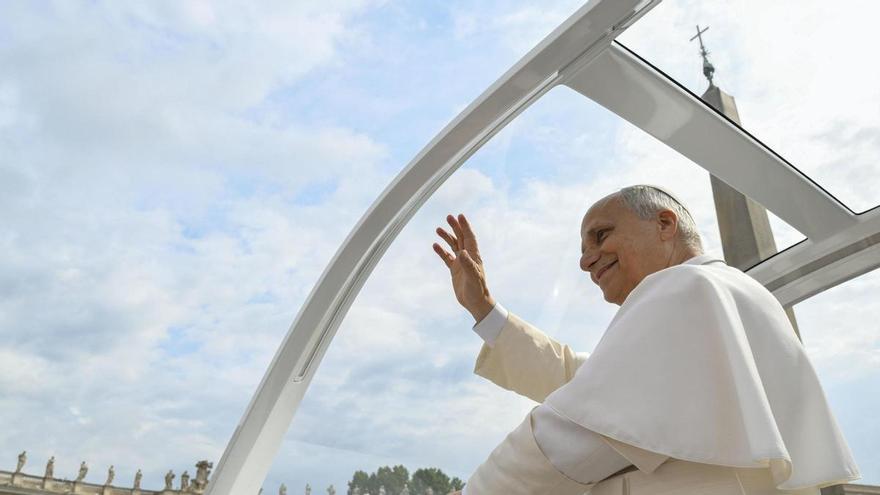
Upon arrival, after touring the surrounding streets in the popemobile, and following the initial rites of the Mass, the Pope was welcomed by the Kings, the Princess of Asturias, and Infanta Sofía, along with the city’s mayor, José Luis Martínez Almeida. Together, they accompanied the Pontiff into the Palacio de Cibeles, where he was presented with the city’s Golden Key.
A sacristy was also set up in the Palacio de Cibeles, where over 150 bishops and cardinals and 1,600 priests donned vestments made for the occasion, inspired by the Cathedral of Almudena.
In addition to the mayor and the Royal Family, the Government was represented by the Minister of Education, Vocational Training and Sport, Milagros Tolón, and the president of the Community of Madrid, Isabel Díaz Ayuso, among others.
Before commencing the celebration, the Archbishop of Madrid, Cardinal José Cobo, speaking from an altar adorned with the Virgin of Almudena, extended words of welcome to the Holy Father: “Before we start this Eucharist, we want to prepare ourselves for welcome: to welcome the successor of Peter, who comes to confirm us in faith, to uphold our hope, and to remind us that the Church is truly herself only when she lives to announce the Gospel and serve the smallest among us.”
More than 400 Voices
The ministry of liturgical singing during the Holy Mass and the Eucharistic procession was entrusted to a choir and orchestra comprising over 400 members from the Orchestra and Choir of WYD 2011, the St. John of Ávila Choir, the WYD Choir, and particularly the treble voices from the Escolanía of the Monastery of San Lorenzo de El Escorial and the Choir of the Abbey of the Holy Cross, who performed a repertoire of more than 25 pieces. Among them was the Gloria preceding the Liturgy of the Word, during which three texts focused on the gift of bread were proclaimed: the passage from Deuteronomy about the manna in the desert (Deuteronomy 8:2-3), Psalm 147, and St. Paul’s teaching to the Corinthians about the one bread that makes many one body (1 Corinthians 10:17). The choir then performed the sequence “Ecce Panis” before the passage from the Gospel of St. John where Christ presents himself as the living bread descended from heaven (John 6:51-58).
A Transforming Grace
The Holy Father’s homily referenced St. Manuel González, known as the Bishop of the Tabernacles, and St. John of the Cross, taking on a profound Eucharistic character. Leon XIV placed the solemnity at the heart of the faith of the Spanish people: “This remembrance of the Lord present in the Eucharistic bread is at the heart of your faith and the history of your people. Here in Madrid, as in many other places in Spain, Corpus Christi is not merely another feast in the liturgical calendar; it is a return to the roots of faith to renew love and fidelity to God.”
He cautioned that the feast is not “a folkloric survival or a mere aesthetic adornment: it is about faith in the presence of the Risen Lord, who is alive and continues to walk among us.” In fact, the Holy Father recalled that “it is no coincidence that, here in Spain, the Church has united the solemnity of Corpus Christi with the Day of Charity for many years.”
Regarding the procession, he specified that “it is not simply about bringing out the monstrance”, but about “allowing ourselves to be extracted from selfishness, indifference, and a comfortable, private faith, to respond to his call for conversion, to change our perspective, and to welcome his transforming presence that makes us builders of a new world.” In this vein, addressing the whole of Spain, the Pope issued an appeal: “Here lies a mandate for the Spain of today and tomorrow: that the religiosity that has animated this country for centuries should not become a museum of the past to visit, but a school of faith from which to draw today.”
He concluded with an invitation to encounter Christ: “Let us return to Him with sincere love. Let us open ourselves to an encounter with Him, allowing Him to refresh the dryness of our hearts, so that we may then go forth to the paths of life and history and carry among the people this stream of fresh water, a flow of love, peace, justice, and joy.”
A school that “teaches us to kneel before God and our neighbour, because no one can kneel before the Lord and despise their brother; a school that teaches us the generosity of love that becomes a gift, so that it may circulate among us and break the chains of all selfishness; a school from which we learn that God is a real presence and that we are also called to be present in the situations and challenges of society.”
And he reminded that the Eucharist does not end with communion: “The Eucharistic grace transforms us, but it also makes us protagonists of the transformation of history and a sign of hope for those we meet.”
The Blessed Sacrament through Madrid
Following the Communion rite, Plaza de Cibeles was reconfigured for the traditional Corpus Christi procession towards Calle Alcalá, specifically prepared for the occasion. In the area where thousands of vehicles pass each day, the monstrance containing the Blessed Sacrament was solemnly carried by the Holy Father, preceded by priests, members of consecrated life, faithful, children who had just made their first communion, authorities, and bishops and archbishops.
The streets along the procession route transformed into an ephemeral canvas thanks to floral carpets crafted for the event. This intricate ornamental work was coordinated by a delegation of 24 master carpet makers from the Galician town of Ponteareas (Rías Baixas), who worked hand in hand with 160 volunteers to create a floral carpet for the Blessed Sacrament.
Indeed, during his homily, the Pope remarked that “the solemn processions of this day have for centuries encapsulated the piety, art, music, architecture, and life of the Spanish people, and today still express and manifest the spiritual sentiment of this country through the beauty and elegance of floral carpets, the altars on the streets, the care of the monstrances and displays, the singing, and the ornaments.” The processional act culminated with the Solemn Eucharistic Blessing with the Blessed Sacrament.
Details of the Celebration
A total of 1.5 million people attended the celebration. The altar, erected in front of Palacio de Cibeles, measures 55 metres in width and 20 metres in depth, topped by a dome 25 metres tall.
During communion, more than 2,100 ministers of communion, including priests and extraordinary ministers, distributed communion using approximately 2,300 ciboria from six churches that remained open until 2:00 PM. The monstrance used in the procession is a piece from 1943, made of gilded silver and adorned with jewels, depicting the four evangelists, funded by popular subscription.
The floral carpets featured over 30,000 carnations, primarily white and yellow, crafted by twenty-four coordinating carpet makers and around one hundred sixty volunteers. The technical setup included 31 LED screens, seven screen trucks—one featuring a 100 square metre screen—, and 608 speakers distributed across 67 delay towers. To cater to attendees, ten points for supplying drinking water were established, alongside 2,300 portable toilets, a waste management system, and an extensive security and fencing system.