Gaudí’s Unseen Legacy in the Canary Islands
Thousands of Canarians walk over one of Antoni Gaudí’s most famous creations without taking a moment to appreciate it. Unlike the Sagrada Família, this piece does not soar skywards, flaunt impossibly tall towers, or feature undulating façades. Instead, it lies underfoot, integrated into pavements and promenades, forming part of the daily landscape in two municipalities of the Canary Archipelago. As we mark the 100th anniversary of the Catalan architect’s death on 10 June, who tragically passed away in Barcelona in 1926 after being struck by a tram, his influence in the Canary Islands emerges in an unexpected way. Not through grand buildings, but through a work that has become one of the most recognisable urban designs in the world.
A Universal Work
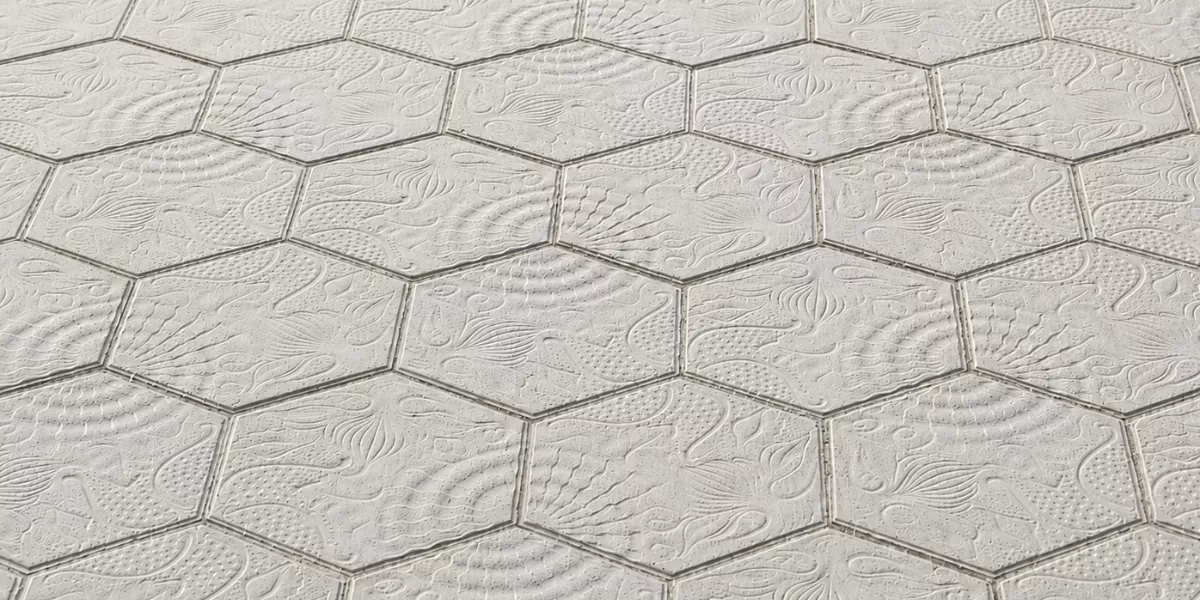
The piece in question is the well-known Gaudí mosaic, also known as the panot de Barcelona, a hexagonal tile envisaged by the architect in the early 20th century. Its popularity is such that it now covers over 60,000 square metres of the Passeig de Gràcia, one of the most iconic avenues in Barcelona. Moreover, the design is part of the collection at the Museum of Modern Art in New York (MoMA), where it is regarded as one of the first significant examples of modern industrial design. Paradoxically, it is one of Gaudí’s most disseminated and reproduced works, despite not being a building or a monumental construction.
Maritime Inspiration
Originally designed in 1904 and manufactured by the historic Catalan company Escofet, the tile perfectly encapsulates the architect’s creative philosophy. Gaudí consistently found inspiration in nature. “This nature which has always been my teacher,” he frequently affirmed. This influence is evident in both the form and decoration of the tile. Its hexagonal structure resembles honeycomb cells, while the reliefs illustrate marine elements inspired by the ocean floor.
A Perfect Puzzle
The true brilliance of the design emerges when multiple tiles join together. Each tile contains only a part of three natural elements: a starfish, an ammonite, and a fragment of sargassum seaweed. None of these elements appears complete on a single tile. The full illustration can only be appreciated when several tiles fit together, creating a kind of giant puzzle. Seven pieces are required to view the design in its entirety as originally conceived by Gaudí. More than a century later, this system continues to astound with its simplicity and the way it blends art, geometry, and functionality.
Impact in Ingenio
The presence of these tiles in the Canary Islands was no coincidence. In the Gran Canarian municipality of Ingenio, the tiles were incorporated in 2001 as part of an urban improvement project around the church of Nuestra Señora de La Candelaria. The initiative was led by architects María del Carmen Rubio and Gema Navarro, along with municipal technicians, who directly acquired pieces from Escofet. Currently, the mosaics cover approximately 890 square metres spread across the town hall pavement, the church surroundings, and various sections of Doctor Juan Espino Sánchez, Ramón y Cajal, and Avenida América. The town hall considers these tiles so important that they maintain reserve units for future replacements.
Saved in Tenerife
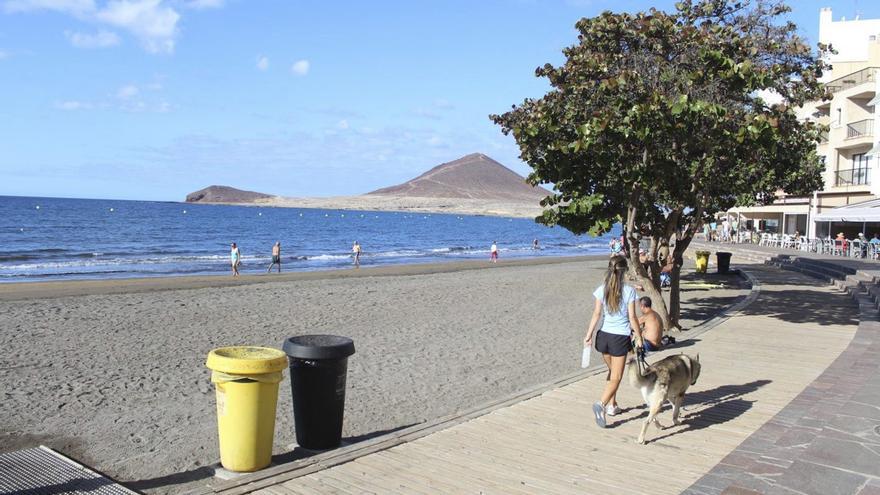
The story of the tiles in Los Cristianos, within the municipality of Arona in Tenerife, nearly ended in disaster. During renovation works on the Paseo de Los Tarajales, the mosaics were removed and risked disappearing forever. The situation changed in 2019, thanks to the efforts of a local resident, Ana González Ledesma, who formally requested their conservation, believing they possessed significant artistic and heritage value. The request was addressed by the Historical Heritage Service of the Tenerife Council, which recommended their recovery and protection. Although it was impossible to return them to their original position due to the advanced state of the works, approximately 70% of the pieces were rescued, allowing for their reuse in different areas of the promenade.
Atlantic Connection
Both Ingenio and Arona share a lesser-known characteristic. The tiles installed in both municipalities belong to a later version of the original design. In the 1960s, Escofet developed a larger variant, with pieces measuring 43 centimetres in diameter, which is precisely what arrived in the Canary Islands. Thanks to this, the archipelago is part of a select international network of cities where Gaudí’s most popular work continues to be integrated into the urban landscape. A discreet yet enduring legacy that connects Barcelona with Granada, Jaén, Cáceres, Castellón, and also the Canary Islands. One hundred years after the architect’s passing, his mark remains evident in the archipelago. It does not rise skyward, nor dominate the skyline; it is much closer—beneath the feet of those who walk daily, unaware that they tread upon a small masterpiece.