Canary Islands Electoral Landscape: Significant Redistribution of Voter Support
The electoral landscape in the Canary Islands, as presented by the Electoral Observatory of the Canary Islands, reveals more than just who gains or loses votes. It offers insights into the movement of voters between parties, ideologies, and political spaces.
### Key Findings
The main conclusion indicates that the political system in the Canaries is undergoing a phase of intense internal redistribution. This is characterised by a more compact right, a nationalist centre facing difficulties, and a left where part of the electorate is shifting towards abstention, indecision, or exploring new political options.
The study’s voting transfer matrices illustrate that while the major parties retain a significant portion of their traditional support, a notable fraction of their current votes originates from former supporters of other parties. This phenomenon particularly affects VOX, Drago Canarias, and Primero Canarias, whereas Nueva Canarias emerges as the party most impacted by a loss of electoral loyalty.
### VOX: Strong Yet Dependent
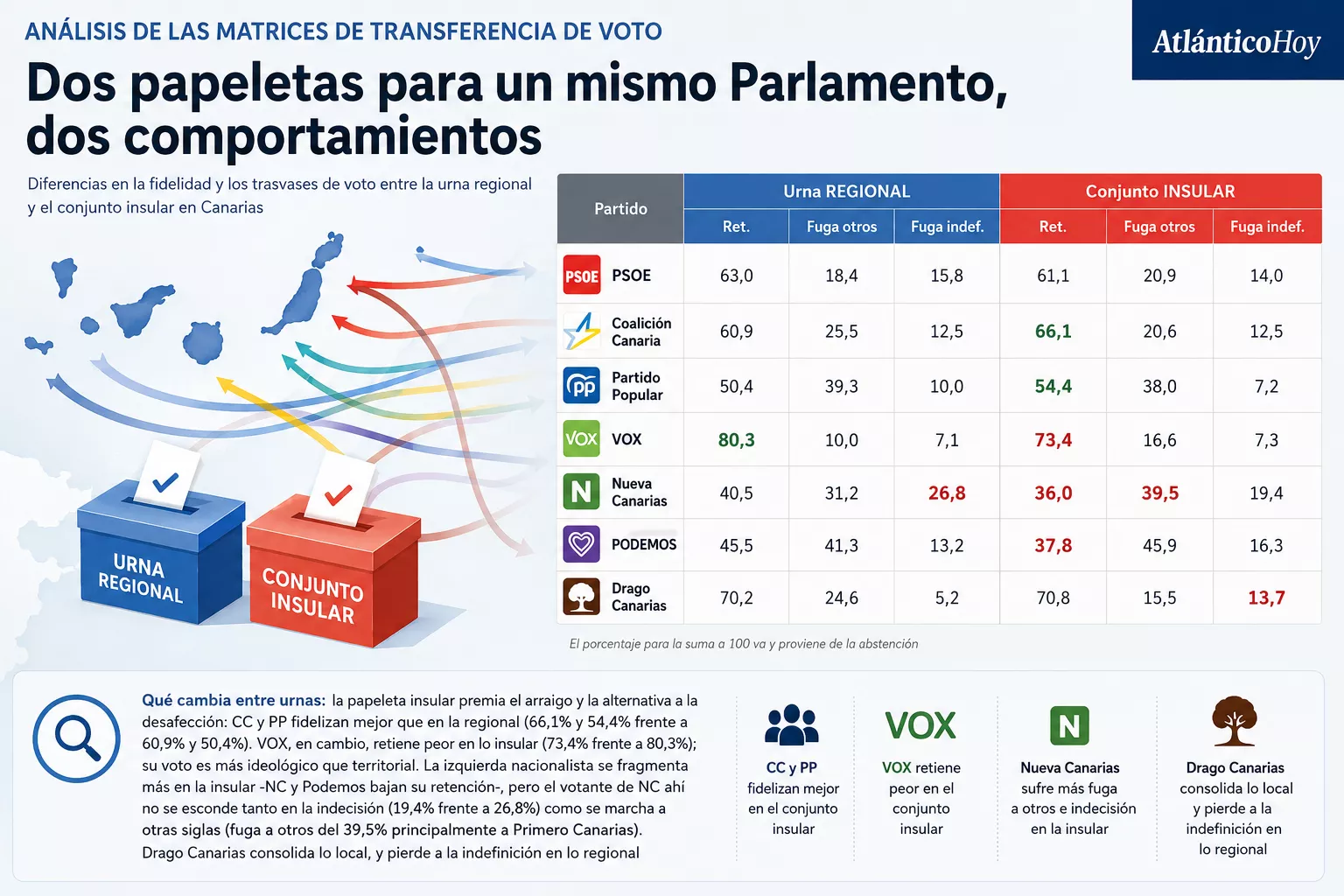
The case of VOX stands out, showcasing the highest electoral fidelity within the entire Canarian political system. According to the study, VOX retains 80.3% of the votes from previous supporters—four out of five—far surpassing any other party. However, a particular aspect of this strength is its reliance on other party supporters; 40.8% of its current electorate comes from parties like the Partido Popular (PP). This situation is described as a “shielded right”, where VOX consolidates its political space with the PP as the main supplier of new supporters.
### The Partido Popular’s Complex Situation
In contrast, the PP faces a more complex scenario. Although it maintains a significant base of support, it only retains 50.4% of its previous voters in the regional ballot, with 39.3% migrating to other political options.
### PSOE: Strong Internal Loyalty
On the contrary, the PSOE continues to be the party with the most insular electoral base in the archipelago. Data reflects that 80.7% of current PSOE supporters previously voted for the party, while a mere 10.3% come from other political forces. Socialist fidelity reaches 63% in the regional ballot and 61.1% across the islands. The challenge for the socialists lies not in losing voters to rivals but in an increasing number of declared undecided voters—15.8% of past PSOE voters are uncertain about their future choices.
### CC’s Stability
Among major political forces, Coalición Canaria (CC) emerges as the most stable and homogeneous organisation in the Canarian system. The nationalist party retains 60.9% of its former voters in the regional ballot and improves to 66.1% overall across the islands. It also exhibits relatively uniform loyalty levels across nearly all islands. The report highlights that CC’s main threat is not other parties but indecision; one in eight former nationalist voters remains undecided about their choices in the upcoming elections.
### New Canarias: The Larger Impact
Nueva Canarias appears particularly disadvantaged in the voting transfer matrices. The party leads negative indicators in the study, retaining only 40.5% of its former voters in the regional ballot and 36% overall. Moreover, it records the highest shift towards indecision compared to other significant political forces, with 26.8% of former voters expressing uncertainty.
### Primero Canarias: New Entrant Dynamics
The emergence of Primero Canarias exemplifies a noted phenomenon. As a newly formed party, it lacks a historical voting record, with its growth primarily stemming from previous supporters of other parties, especially Nueva Canarias. The data indicates that 91.5% of its regional electorate and 88.8% of its island votes come from other parties.
### Voter Indecision as a Major Factor
A crucial takeaway from the study is the significant weight of indecision in the electorate. This ‘hidden pool’ primarily consists of individuals who were previously disengaged from the political system. 56.8% are former abstainers or individuals who had no prior party affiliation. In contrast, 43.2% signify those no longer supporting specific parties, including past voters of the PSOE, CC, PP, and Nueva Canarias.
### Municipal Elections: The Insular Branding Strengthens
When analysing cabildo elections, voter behaviour shifts. The insular ballot enhances territorial ties, significantly benefiting Coalición Canaria, which improves its fidelity to 66.1%. The PP also strengthens its retention compared to regional elections.
### PSOE as a Key Donor in Urban Areas
In Santa Cruz de Tenerife, Drago Canarias stands out for successfully attracting votes from other parties, with 64% of its current electorate originating from various political sources. Meanwhile, in Las Palmas de Gran Canaria, the PSOE inadvertently serves as a critical supplier of support for smaller parties.
### Conclusion
The electoral dynamics in the Canary Islands indicate a less defined battle between blocks and instead highlight an intense internal redistribution of support among parties. The study was conducted through 1,639 interviews from 19 to 25 May 2026, ensuring representation across the islands to facilitate specific analyses by constituency.