The rehabilitation of 375 public housing units in Arona remains stalled three years after the municipal government changed, as reported by the PSOE during a visit to several residential developments in the municipality. This initiative was part of a strategy designed to modernise a significant portion of Arona’s public housing stock, improve living conditions for hundreds of families, and advance the regularisation of situations that have persisted for decades. However, the socialists claim that this roadmap was halted after the 2023 municipal elections, and that no significant progress has been made on the planned projects since then.
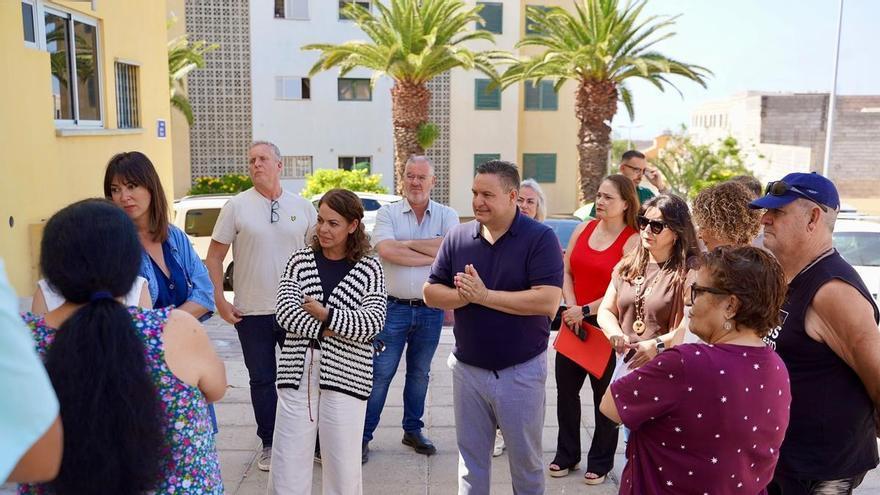
The visit included the participation of the socialist spokesperson on the Arona City Council, José Julián Mena; the General Secretary of the PSOE of Tenerife, Tamara Raya; the Secretary of Organisation of the PSOE of the Canary Islands, Nira Fierro; socialist councillors from the municipality, and representatives of the Socialist Parliamentary Group. They witnessed firsthand the situation in several public developments where residents continue to demand structural improvements and permanent solutions to issues that have remained unresolved for over thirty years in some cases.
A Project for Four More Developments
The starting point was the Virgen del Carmen urbanisation in Guargacho. In 2018, the City Council began the procedures to include this residential complex in an Urban Regeneration and Renewal Area (ARRU), a framework that facilitates funding from various administrations to execute comprehensive rehabilitation projects. The works were awarded in April 2023 with an investment of €2.8 million, jointly financed by the State, the Government of the Canary Islands, the Cabildo of Tenerife, and the Arona City Council. This intervention enabled improvements to the 70 homes in the urbanisation, enhancing façades, roofs, accessibility, and communal areas.
The socialists aimed to turn this project into the first phase of a wider programme intended to extend rehabilitation to other public housing developments in the municipality. The plan included interventions in the San Martín de Porres and Santa Rita urbanisations in Cabo Blanco; Hermano Pedro in Arona casco; and Mazapé in Vento. Collectively, these actions would improve living conditions for around 375 families residing in public housing. However, according to opposition members, none of these projects have progressed over the past three years.
During the visit to Cabo Blanco and Arona casco, numerous residents expressed their concerns about the progressive deterioration of the buildings and the lack of investments for their rehabilitation. Complaints focused on the state of conservation and the absence of actions to modernise developments built decades ago.
Affected families reside in the urbanisations of Cabo Blanco, Arona casco, Guargacho, and Vento
Adding to these demands is another historic claim: the situation of families still waiting to gain ownership of the homes they have occupied for years. According to residents, many of the processes initiated to facilitate future deeds are still pending, despite the time that has passed.
The socialists recall that during the previous term, significant administrative progress was made to unblock the files for Hermano Pedro and Mazapé, allowing continued processing with the Canary Islands Housing Institute. However, definitive solutions are still lacking.
For José Julián Mena, the halting of rehabilitation projects “represents the interruption of a strategy” aimed not only at improving buildings but also at strengthening social cohesion in entire neighbourhoods and providing legal security to hundreds of families.
The socialist spokesperson asserts that public housing is one of the primary concerns of Arona residents, and he believes that the lack of continuity in the projects “exacerbates existing difficulties” in a context marked by continually rising housing prices and a shortage of affordable alternatives.
After three years in office, the developments that were to benefit from the second phase of the rehabilitation programme “continue to wait.” In the meantime, the 375 families mentioned in that planning “remain unaware of when actions conceived to fundamentally transform a significant portion of the municipality’s public housing will be implemented.”