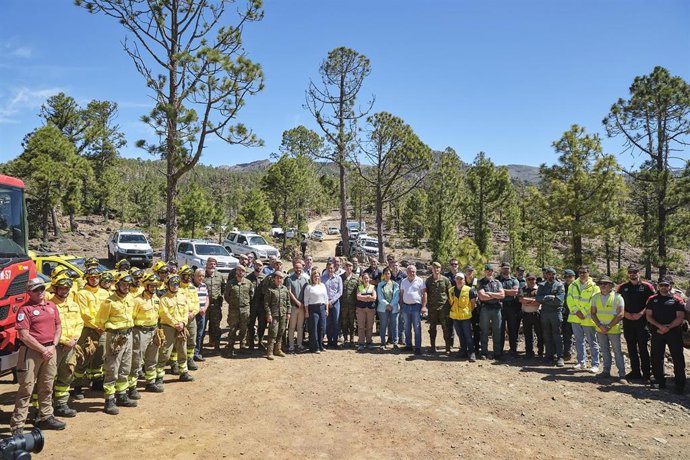

– ELENA DE LA CRUZ
SANTA CRUZ DE TENERIFE, 8 Jun. (EUROPA PRESS) –
The Cabildo of Tenerife has launched its forest fire campaign for the summer of 2026, enhancing all human, technical, and logistical resources to prevent and tackle wildfires. This initiative is based on anticipation, innovation, and inter-administrative coordination.
According to the island’s president, Rosa Dávila, the 2026 plan significantly strengthens available resources, deploying over 760 personnel. This includes 216 from BRIFOR, comprising technicians, prevention staff, and specialised brigades. The operation will also see 105 personnel dedicated to fire-fighting, 176 volunteers, along with forestry firefighters, the Fire Brigade Consortium, environmental agents, and civil protection officials.
Notable updates include an enhanced capacity for the Rapid Intervention Brigades (BRIVAM), which will be strategically deployed across the island. Additionally, the number of emergency management technicians will rise from 8 to 11, as specified by the island corporation in a statement.
ADDITIONAL RESOURCES
The plan will also see support from GESPLAN, with an additional 105 professionals and operational brigades stationed at various locations around the island, along with round-the-clock surveillance and specialised technical staff.
The initiative comprises 22 heavy forest fire engines, with a capacity of 3,500 litres, 2 supply trucks holding 9,000 litres, 2 light fire engines with a capacity of 1,800 litres, and 27 pickup trucks with 450-litre capacity, all designed to access rugged terrain. By the end of the year, two additional light fire engines and six pickup trucks will join the fleet, significantly modernising the fire intervention vehicles.
“These fire engines have drastically improved our intervention capabilities. They can reach areas where access was previously difficult and allow for rapid action during the initial moments of a fire,” emphasised Dávila.
In addition to the new vehicles, the Cabildo operates two helicopters throughout the year, capable of carrying 1,000 litres each (which demonstrated their capabilities during today’s presentation), alongside two state helicopters and one from the Government of the Canary Islands.
The Councillor for Security and Emergencies, Blanca Pérez, clarified that the main goal of the initiative is to “prevent large wildfires by responding swiftly and effectively from the outset,” ensuring that any small blaze does not escalate into a larger emergency.
During periods of high alert, an “emergency mode” will be activated, with all available personnel ready for immediate intervention, particularly during heatwave episodes.
TECHNOLOGICAL SYSTEM
José María Sánchez, a BRIFOR technician, outlined the human and material resources available for this year, noting that “the entire fire danger zone and seasonal weather conditions are monitored by aerial resources deployed across the island’s geography.” He also highlighted an increase in night-time firefighters’ presence as a new feature.
The campaign has introduced an advanced surveillance system, utilising 14 drones, two of which are equipped with thermal and visual cameras, enabling early detection of blazes even under low visibility conditions. Furthermore, a high-precision thermal camera will be installed at the Los Topos watchtower, enhancing the ability to detect heat sources over long distances.
“Innovation is crucial. We are investing in technology that allows us to preemptively address fires and respond with greater speed and effectiveness,” the island president emphasised.
90% MONITORING
The Councillor for Innovation, Juan José Martínez, explained that the project represents an investment of nearly four million euros, enabling the monitoring of up to 90% of the island’s forested areas through a network of towers fitted with thermal and standard cameras, tailored to the island’s challenging topography.
This innovative and autonomous system, in terms of energy supply and connectivity, will continue to operate even in emergency situations. It also integrates artificial intelligence to identify potential fire outbreaks and minimise the response times of intervention teams. Additionally, the platform will monitor volcanic, hydrological, and meteorological risks.
The councillor also indicated that the project will grow in the coming years by incorporating data from the future Canary satellite constellation.
FUTURE SENSOR NETWORK
Innovation technician David Pérez noted that the camera installed at the Los Topos tower in Vilaflor is a key component of the Integrated Emergency Management System (SIGE), “a platform that enhances its effectiveness when all elements share information and collaborate.”
He mentioned that the integration of tools such as the future sensor network, CIVIFORM, and monitoring nodes is expected to significantly improve the capacity for emergency prevention and response.
This 25-metre-high tower operates autonomously, powered by solar energy, with backup systems and resilient communications ensuring uninterrupted operation 24 hours a day.
OPERATION PROMETHEUS
The initiative is further strengthened by the new edition of Operation Prometheus – Sentinel Tenerife, a collaboration between the Cabildo and the Ministry of Defence, led by Margarita Robles. This time, nearly 3,000 troop and command days will be utilised, with the addition of military drones.
This operation will deploy ground patrols in high-risk areas until 30 September, especially in urban-forest interface zones. Daily there will be 10 patrols, rearranged to cover the southern midlands where the risk is anticipated to be greater.
“The presence of the military significantly reduces the incidence of fires. This operation saves lives, protects our environment, and reassures the public,” stated Dávila, who highlighted “the combined effort and citizen collaboration” as essential: “Prevention begins with every daily action.”