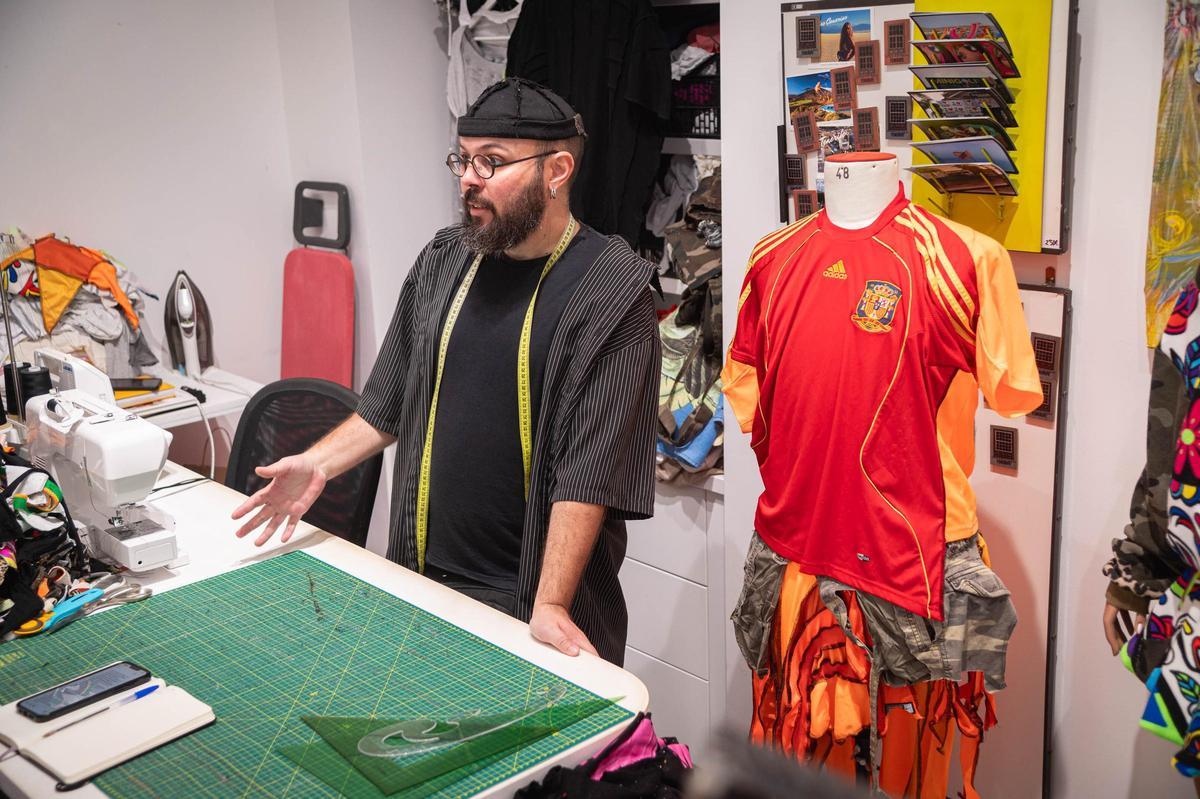
With a tape measure around his neck and hands guiding the last fabric pieces under a sewing machine needle, Juan Labory works surrounded by fabrics that have long ceased to be mere waste. Around him, five mannequins display the garments from his new collection in a space that serves as both a shop and a workshop. In the heart of San Agustín Street in La Laguna, the Tenerife designer shapes a project that transforms waste left by tourists into fashion, which is often repurchased by those same visitors, completing the cycle.
From Tenerife with More Resilience
His new campaign, ‘From Tenerife with More Resilience’, aims to denounce mass tourism and the impact of industries like fashion, which according to the UN is the second most polluting sector after oil. “The world of art is very limited, especially in islands like ours,” Labory laments, “that’s why I create fashion for those who choose to live here, aiming to make Tenerife a cutting-edge place.” “Moreover, I try to engage in activism and social criticism regarding the tourism situation in the Canaries. It’s amusing, as I give a second life to towels left by tourists and sell them again,” the designer continues with a smile.
To transform raw materials, which some deem waste, into sweatshirts, skirts, or trousers, Labory— also the name of the brand— utilises upcycling as the central technique to realise his ideas. However, this method differs from typical recycling, as the latter breaks down waste into its primary forms through industrial processes. In this instance, the designer directly modifies existing garments or objects to enhance their aesthetic and functional value without breaking down any material.
“I take what people no longer want, and instead of discarding it, I give it a new life from scratch, without transforming or customising. With those materials, I cut and create new fabrics with patterns of my own,” explains the designer from La Laguna. Towels discarded by ‘tourists’ are his favourite resource. He personally sources items from clothing collection entities, like Ataretaco, where he also serves as creative director, or directly from hotels in search of materials to give a fresh start. “It’s something truly novel; it’s the first time anything like this has been done in Tenerife,” he proudly states.
From Tenerife to Berlin, from Berlin to La Laguna
He learned this unique and distinct way of working in Berlin, where he studied fashion after leaving his long-time home in the Canary Islands to pursue his dream. Although he has always had a love for second-hand, sustainable, and vintage clothing, his fascination with the German capital helped him define his authorial style, inspired by the city’s vibrant atmosphere and creative values. “So many cultures converge in one city,” he illustrates, “creating a very special community of artists.”
After his time in Germany, he returned to Spain, this time to another capital, Madrid. “I worked as a stylist, doing fashion editorials, working in advertising… until I grew a bit tired of instability. After four years, as I had always wanted to launch my fashion project, I decided to return home and do what I always knew I wanted to, and why not, in La Laguna,” he recalls.
“Initially,” he admits, “I envisioned making a shop-workshop so that customers could observe me working on the garments which I would sell later.” Ultimately, his long-awaited dream became a reality. A dream that has been a reality for over three years.
“People are shocked when they see the type of clothing I create, as they’re not used to such designs. I even try to adopt a pedagogical role, teaching the reasons for promoting sustainable fashion and fighting against the waste caused by the phenomenon of fast fashion and the ultra fast fashion,” he states.
A Blend of Fashion, Art, and Activism
In the future, Labory aims to continue expanding the reach of his project without losing the essence that has defined it since its inception in La Laguna: the “blend of fashion, art, and social activism.” Therefore, his goal is not merely to grow as a brand commercially but also to solidify a way of understanding textile creation as a tool for awareness.
The designer aspires to take his work beyond his shop space and enter educational and cultural environments where he can create a direct impact on new generations. “I envision fostering an educational role, influencing people more, raising awareness…,” he stated before returning to sewing a couple of fabric pieces, while also considering “developing workshops in schools and extending his proposal to museums“, moving away from the conventional fashion circuit.
For all these reasons, Juan Labory summarises, “We need to be conscious of what we buy, how we do it, and where we do it. And that is inherent in what I do: I am an activist for sustainable fashion.” This phrase encapsulates his work’s philosophy in just a few words. His fashion not only reuses materials, but it also reuses discourses, transforms them, re-signifies them, and returns them to the public space in the form of garments to convert waste into design and design into message.