Port of Las Palmas Reports Mixed Results for Early 2026
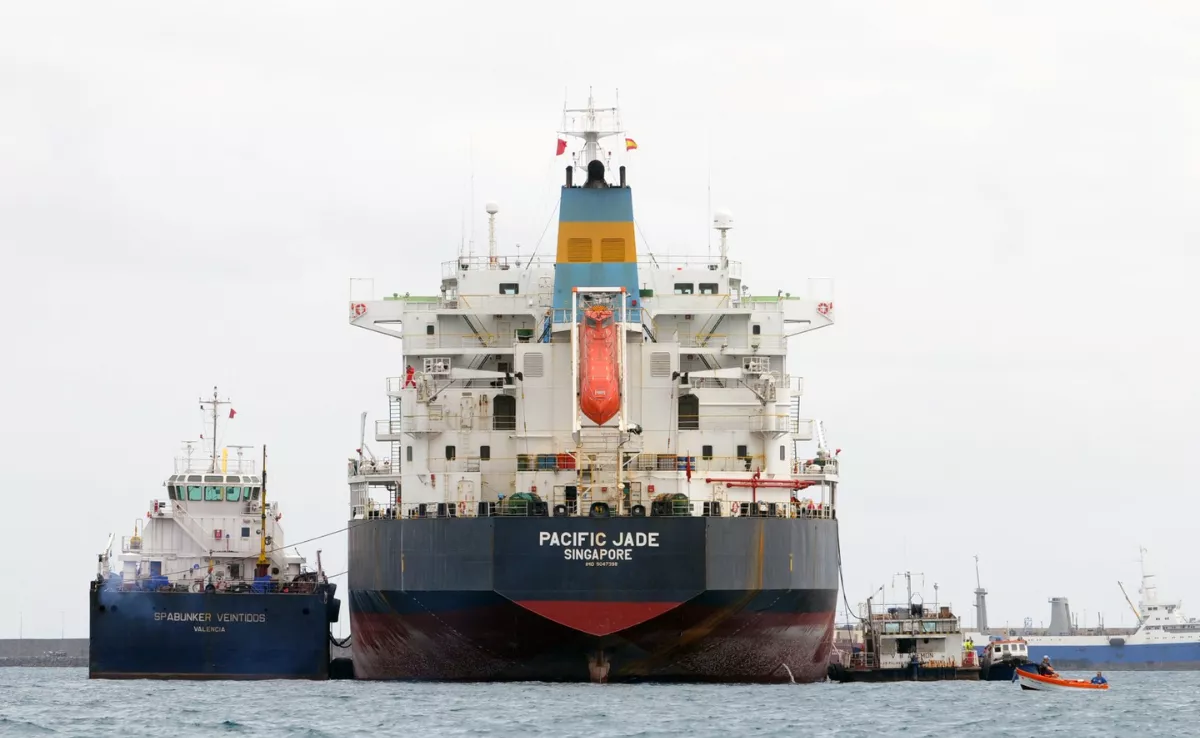
The statistics for the first five months of 2026 present a bittersweet picture for the Port Authority of Las Palmas (APLP). Overall traffic remains healthy, recording 14,870,306 tonnes, which is an increase of 284,072 tonnes or 1.95%. However, the port’s leadership expresses concern over the ongoing decline of one of its strategic pillars: fuel supply (bunkering), which has seen a year-on-year drop of 6.70% (1,083,023 tonnes compared to 1,160,818 tonnes last year).
### Concerns Over Bunkering Downturn
“The bunkering sector is essential for the Port of Las Palmas, which is why we are worried about the slight decrease we’ve experienced in recent months,” stated Beatriz Calzada, the president, in a press release.
The APLP indicates that it has been analysing the causes of this decline for “months”, directly blaming the Maritime Captaincy of Las Palmas, which imposes stricter safety measures than those in Santa Cruz de Tenerife for operating in its ports. The APLP links the downturn to weather disruptions and these heightened requirements. However, the regulations cited have been effective since April 2019 and apply equally to Algeciras and Barcelona. Essentially, for the last seven years, following a two-year moratorium, only double-hulled or double-engine barges have been permitted to operate in the ports of Las Palmas.
### Challenges with Single-Hulled Barges
The decrease in fuel supply was most pronounced in January (-0.69%), March (-2.48%), April (-7.27%), and May (-6.68%), with only February experiencing a brief respite (+4.96%). Despite the consistent regulations since 2019, the APLP identifies a single-hulled barge as a destabilising factor. This vessel can load fuel at the Port of Las Palmas but is prohibited from operating in its waters by the local Maritime Captaincy due to safety concerns.
The conflict arises because the Santa Cruz de Tenerife Maritime Captaincy deems the barge safe for its port, allowing it to move to another island and dispatch fuel there, thus improving the statistical figures for that province.
Calzada elaborated, “The explanation for the decrease in fuel supply seems mainly tied to a single-hulled barge that cannot operate in our port… However, this barge loads fuel at the Port of Las Palmas and supplies it at the Port of Santa Cruz de Tenerife, resulting in the tonnes being counted there instead of here.” Had this cargo been included at its origin, the Port of Las Palmas would have experienced a 12.16% increase in bunkering, totalling 1,210,947 tonnes instead of the current record of 1,079,636 tonnes. The APLP notes that a total of 255,477 tonnes of fuel faced similar diversions in 2025. Had these been accounted for in Gran Canaria, Las Palmas would have closed last year with a 10% increase in volume, nearing 2,858,580 tonnes in total bunkering.
### Overall Port Performance
Despite the setbacks in the fuel sector, the overall performance remains positive, buoyed by growth in other commercial activities. Below is an analysis of the major economic sectors at the port, listed by relevance and volume in their indicators:
#### Logistics
This sector generates the highest volume at the port. General container cargo saw a slight decline of 1.17% (6,313,062 tonnes), but container movement increased by 3.96% to reach 620,622 TEUs in the province. In the Port of Las Palmas alone, container numbers rose by 4.10% (572,348 TEUs), reinforcing its leadership in connectivity even as the tonnage of this cargo fell by 1.37% (5,930,050 tonnes).
#### Inter-Island Trade
Ro-Ro (Roll on/Roll off) transport continues to demonstrate remarkable resilience, reflecting the vibrancy of trade within the archipelago. Overall Ro-Ro traffic increased by 3.15% (159,457 units), while the volume rose by 6.65% (2,473,404 tonnes). In the Port of Las Palmas, these figures were even more impressive, with a 9.70% increase in tonnage (1,719,011 tonnes) and a 5.23% rise in units (107,387).
#### Passengers and Cruises
The tourism and civil mobility sector is reporting record figures, with overall growth of 4.38% (1,811,619 total passengers compared to 1,735,648 in 2025). This increase is solely attributed to an impressive performance in cruise traffic, which rose by 9.24%, counterbalancing a 5.82% decline in regular ferry lines. In the Port of Las Palmas, the general passenger increase stands at 5.44% (1,114,431 clients), driven by a remarkable 15.03% rise in cruise passengers, while regular line passenger numbers fell by 4.81%.
#### Fishing Sector
Frozen industrial fishing has emerged as a significant surprise this year, showing historic growth in volume. Overall, it soared by +59.50% to reach 154,591 tonnes. In the Port of Las Palmas, the rise was even greater, with a 61.07% increase, culminating in 152,446 tonnes of frozen catches. In contrast, fresh fish remains a minor activity, with mixed results; it increased by 13.26% across the province (reaching only 205 tonnes) but plummeted by 27.27% in the Port of Las Palmas, where only eight tonnes were offloaded.
### Performance by Ports and Facilities
The 1.95% growth in Port Authority operations has not been evenly distributed among its facilities. The Port of Salinetas leads relative increases with a spectacular rise of 45.15% (315,514 tonnes), followed by the Port of Arrecife (+3.61% and 844,015 tonnes), the Port of Las Palmas (+1.20% and 12,906,722 tonnes), and the Port of Puerto del Rosario (+0.88% and 695,636 tonnes). Conversely, the Port of Arinaga is the only facility to report a decline, registering a drop of 2.31% with 108,419 tonnes handled.