Luis Yeray Gutiérrez receives a document from the Bishop of Tenerife, Eloy Santiago, which will become part of the valuable documentary heritage held by the Archive
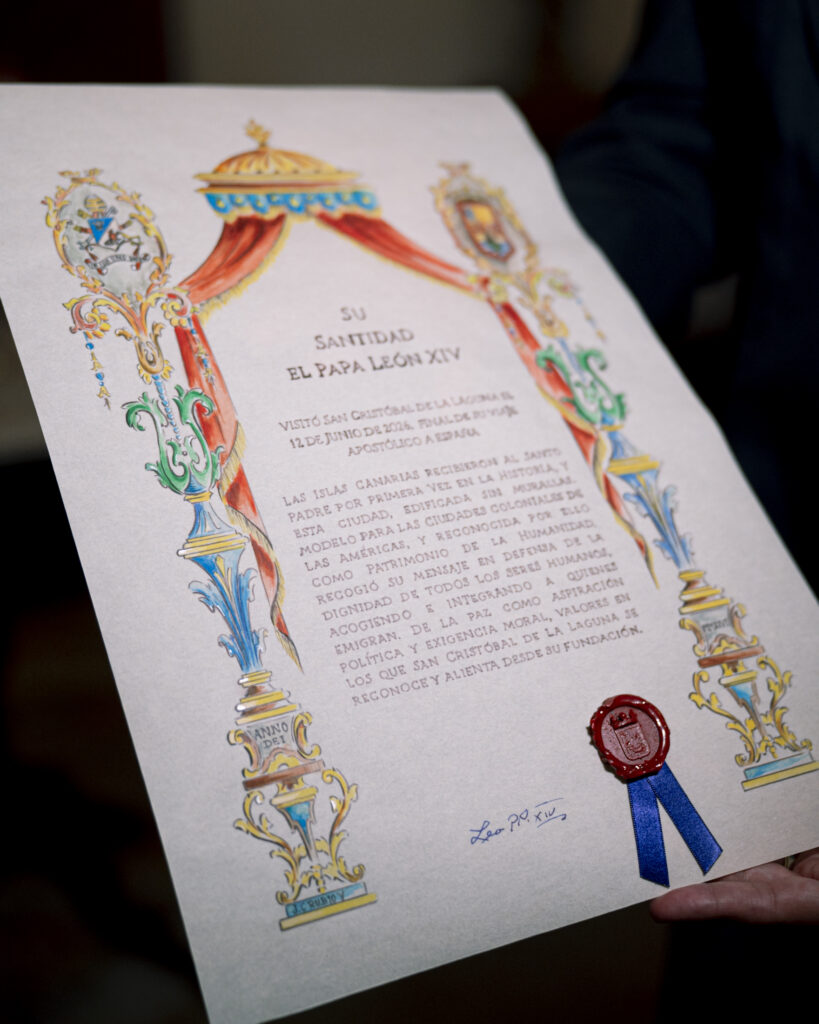
Last Friday, Pope León XIV signed a document confirming his visit to San Cristóbal de La Laguna. This document will be kept in the Municipal Archive, regarded as the most significant in the Canary Islands from the perspective of civil archiving.
On Tuesday, the mayor received this document from the Bishop of Tenerife, Eloy Santiago, with the original being added to the valuable documentary heritage of the Archive. This Archive houses essential funds of the history of the island and city, including the original manuscript from 1510, where Queen Juana of Castile, known as ‘Juana la Loca’, granted the city its coat of arms in her own handwriting. The Council’s intention is to create a facsimile copy of the document signed by the Pope to facilitate its dissemination.
“We must thank the Pope for his warmth and cordiality shown during his historic visit to San Cristóbal de La Laguna and his message defending human dignity,” stated Luis Yeray Gutiérrez. “We also appreciate that he was kind enough to sign this document, enriching the valuable collections of our Municipal Archive. While it may seem a minor gesture amid the countless photographs, videos, and newspapers capturing his visit to La Laguna, history will show that this document will be studied as an exceptional piece in the future.”
The Bishop of Tenerife expressed his “great joy that Pope León XIV visited the city of San Cristóbal de La Laguna, walking these streets and experiencing the affection of the locals. Today we present this signed text,” which represents “another page in the significant history of this World Heritage city and it is an honour to have been present at such an important moment.”
The Pope signed the document during his visit to the Palace of Salazar, the seat of the Bishopric of Tenerife, following the event in the Plaza del Cristo and a drive through the streets of Viana and San Agustín. After addressing the public from the balcony of the episcopal headquarters, León XIV held a brief private meeting with the Bishop of Tenerife, at which he affixed his signature to the document.
The text of the document reads: “His Holiness Pope León XIV visited San Cristóbal de La Laguna on June 12, 2026, the conclusion of his apostolic journey to Spain. The Canary Islands welcomed the Holy Father for the first time in history, and this city, built without walls, serving as a model for colonial cities in the Americas and recognised as a World Heritage site, received his message advocating for the dignity of all human beings, welcoming and integrating migrants, and pursuing peace as a political aspiration and a moral imperative, values that Santa Cristóbal de La Laguna has embraced since its foundation.”
The initiative to present the Pope with this document originated from municipal technician Jesús Gil García, supported by the director of the Municipal Archive, Daniel Melián, who is part of the Council’s Presidency department, led by councillor Carla Cabrera. The illustration and handwritten transcription of the text were completed by the Córdoba artist José Carlos Rubio Valverde. Rafael Martín Cantos, the head of the Graphic Document Restoration Centre of La Laguna City Council, oversaw the condition of the document prior to the Pope’s signature.
Manuscript of Queen Juana and the Key to the World Heritage City
Through the Bishopric of Tenerife, the Mayor of La Laguna presented two gifts from the Municipal Corporation to León XIV in memory of his visit: specifically, a facsimile copy of the document from Queen Juana of Castile, daughter of the Catholic Monarchs, through which she granted the city’s coat of arms when it was the capital of the island of Tenerife; and the Key to the World Heritage City, a unique silver piece that combines a tribute to the Baroque tradition of Lagunero silverwork with a reinterpretation of the compass rose. In the accompanying letter, the Mayor reminds the Pope that “although San Cristóbal de La Laguna was the first non-fortified Spanish colonial city, and was therefore recognised by UNESCO as a World Heritage site, this key symbolises our character as a universal, hospitable city open to the world,” and conveyed to the Pope “the deep gratitude of the entire Lagunera community” for his visit and his “hopeful message defending human dignity.”