The conclusion of the second round of phylloxera surveys conducted across the Canary Islands has resulted in the detection of only four new positive cases. This was confirmed on Tuesday by the Regional Minister of Agriculture, Livestock, Fisheries, and Food Sovereignty of the Government of the Canary Islands, Narvay Quintero, who chaired the technical follow-up meeting addressing the management of phylloxera. The meeting discussed the current situation of the pest and reviewed actions taken since its detection.
The minister explained that these new cases were identified between April and May on abandoned estates located within ‘ground zero’, corresponding to the area of the Protected Designation of Origin Tacoronte-Acentejo.
He stated that these results “demonstrate the effectiveness of the control and eradication measures that we have been implementing over the past year with the regional government, in collaboration with the Regulatory Councils of the Protected Designations of Origin of Wines of the Canary Islands and the island councils, as we have prevented the pest from spreading to other areas of the archipelago.”
9,610 Surveys Conducted
Specifically, he referred to the detection work, indicating that to date, a total of 9,610 surveys have been conducted. Among these, 1,831 were carried out this year, yielding only these four positive results, while 7,779 were conducted last year, with 89 positive outcomes, all located in Tenerife, where the material has already been treated and removed.
Of the surveys conducted this year, 1,054 took place in Tenerife, which remains the only island with the presence of phylloxera.
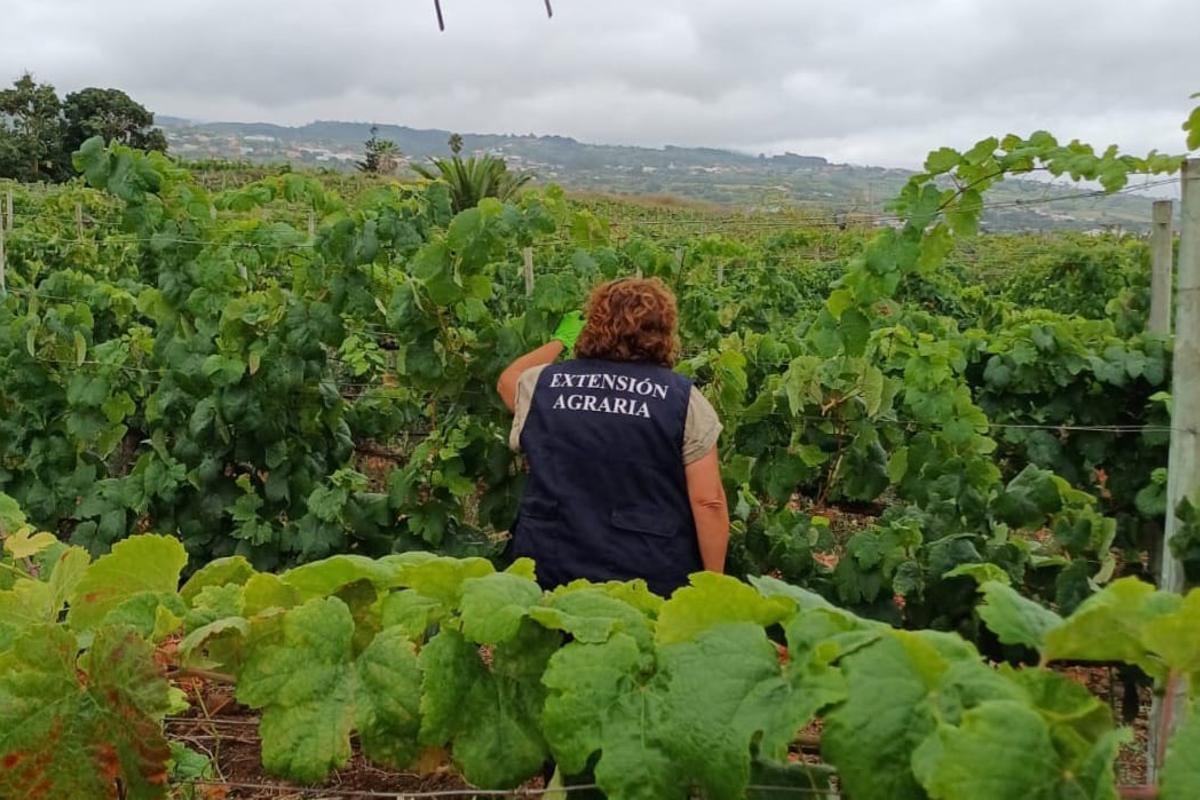
An inspector from the Cabildo de Tenerife during a phylloxera control check on an estate in Tacoronte / E. D. / L. P.
On Lanzarote, 346 surveys have been conducted; in La Palma, 142; in Gran Canaria, 110; in El Hierro, 71; in Fuerteventura, 67; and in La Gomera, 41, according to a statement from the Ministry.
In this regard, Quintero announced that “with no cases outside the demarcated area, and as the situation is under control, we will begin working on amending legislation to relax phytosanitary measures in preparation for the upcoming vintage,” referring to the Order of 20 August 2025, which declares the fight against vine phylloxera in the Canary Islands of public utility and establishes urgent measures for its control and eradication.
A “Very Tough” Vintage
“The previous vintage was very tough for farmers, but we managed to salvage it with a strict control that met the needs of the moment and a situation that was, at that time, unknown,” he emphasised.
During this meeting, which also included participation from the Deputy Minister of the Primary Sector, Eduardo García, technical staff from the Plant Health Service and the public company Management of Rural Environment of the Canary Islands (GMR Canarias), as well as representatives from the Regulatory Councils of the Protected Designations of Origin of Wines of the Canary Islands, island councils, Professional Agricultural Organisations, and the Nature Protection Service, Seprona, among others, the effects of the measures implemented since the first detection of the pest in July 2025 were also discussed.
The highlights of the study on the current state of viticulture in the Canary Islands were also presented, forming the basis of the Strategic Plan for Vine in the Canary Islands, a commitment adopted by the Canary government following the detection of the pest and which has been in progress since last year.
Additionally, actions taken by the Government of the Canary Islands since the detection of this harmful organism were reviewed.
Resistant Vine Varieties
Among other measures, Quintero highlighted the trials conducted with resistant vine varieties, a project focused on analysing the agronomic performance of different rootstocks from traditional Canary varieties and their adaptation to the various soil and climatic conditions in the archipelago.
This initiative is taking place on parcels of approximately 2,500 square metres, where owners have voluntarily opted to participate. These parcels are associated with the Protected Designations of Origin of Wines of the Canary Islands and are located on the islands of Tenerife, La Palma, La Gomera, Gran Canaria, Lanzarote, and Fuerteventura.
The Ministry covers the cost of the actions, takes responsibility for the grafting through specialised personnel, and carries out technical monitoring throughout the project’s duration, which is estimated to be five years.
Financial Support
Additionally, financial compensation has been planned for participating farmers, including an aid of €4,000 in the first year, corresponding to the implementation phase, and an additional €1,000 during each of the following four years, allocated for the maintenance of each trial plot.
The minister also stated that the work carried out by the Government of the Canary Islands falls under the national programme for the application of phytosanitary regulations: Phylloxera contingency plan, prepared by the Ministry of Agriculture, Fisheries, and Food, which lays the groundwork for addressing any future eventualities.
This is the first plan of its kind implemented in Spain and includes many of the actions and measures carried out in recent months.
In this context, Quintero stated that in the Canary Islands we are now in the “eradication phase“, which could potentially make the archipelago the first European region to eliminate this pest if the process is successfully completed, as it remains contained but not completely eradicated elsewhere.