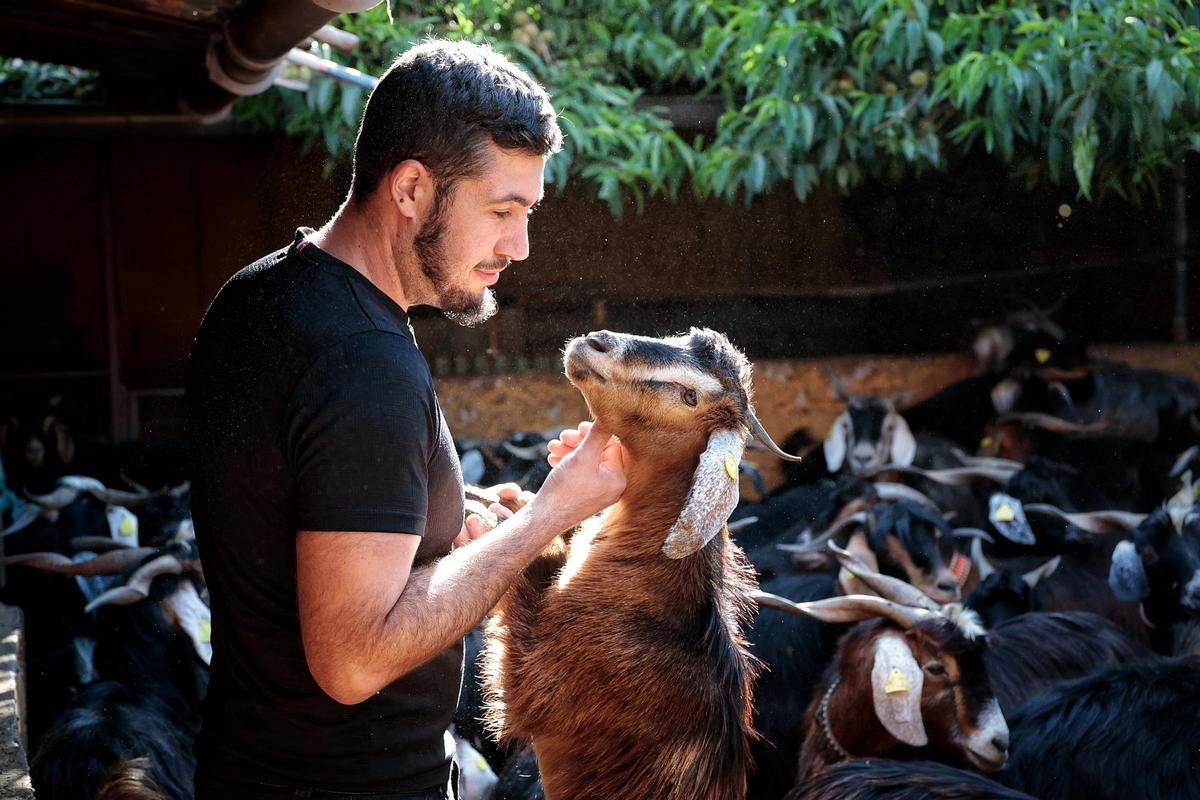
Urbano López Bonilla, quesero de Tacoronte / María Pisaca
Urbano López Bonilla is the last cheesemaker in Tacoronte. Tagoror is the name of his production, a cheese that won a silver medal for fresh cheese made with raw goat’s milk at the Pinolere competition. This provided a boost, and currently, none of the cheese he produces goes untouched in the fridge until the next day. He is considering growth, but not too much; just enough to fully dedicate himself to his goats.
What sparked your interest in goat farming?
I started with a few goats my father owned. He always had goats, although they were not of the breed I work with now, the Tenerife Norte. He had a bit of everything. When I turned 16 or 17, I began buying my own goats. Animals always intrigued me, but between my studies and my age, I wasn’t sure I wanted to start my own flock. As my father already had goats, I took the plunge. My goats grew stronger, and eventually, I ended up with the whole flock. Today, I have about 80 goats.
A family affair.
Yes, my grandfather had two or three goats, the typical amount back then to have milk at home. This evolved to my father, who once had up to 25. And now here I am, with around 80.
You also studied at the Agricultural Training School.
At 19, I decided to receive formal training as I had always been linked to farming. I have vocational training in agriculture, gardening, and livestock, which led me to join the school through my bond with animals. Livestock is connected to agriculture, and there wasn’t an exclusively livestock-based course, so I had to do both. I trained in agriculture for one year and livestock for another.
Did this training provide knowledge you hadn’t acquired at home?
Yes. I went in a bit overconfident, thinking: “I know about animals; they won’t teach me much; I’m just going to get the qualification.” But I was mistaken. I learned a great deal there: new techniques, cheese-making practices, and much that I was unaware of. It is also true that day-to-day experiences teach you what isn’t covered in school. Having animals, seeing how they get sick, or facing a real livestock situation changes everything. They teach you how to do it, but situations arise where you think: “What do I do now? They didn’t teach me this.” A difficult birth, a sick goat, or one that dies in labour at 1 AM. Which vet do you call at that hour? Those things are learned through practice. You encounter a situation once, and then two years later, you already have an idea of how to act. In the end, you become somewhat of a vet.
If I take the goats away from here, Tacoronte will be left without cheese and without goats.
What does a normal day in your life look like?
I wake up at five in the morning, get ready, and go to work, as I don’t focus solely on this. I have another job that guarantees me a salary every month, while with the goats, I aim to ensure they sustain themselves, and if they leave anything for me, that’s even better. I start working at seven, and depending on the week and my workload, I might finish at three, four, or five in the afternoon. Afterward, I return home, have lunch, and dive into goat-related tasks. I’m usually there until at least ten at night.
So you dedicate your afternoons to cheesemaking.
Entirely. There’s milking and feeding the animals to do. While I’m at work, my parents feed them so they don’t have to wait until late. By the time I arrive, they’ve already had breakfast, but I need to provide lunch and dinner. I also milk, set the cheese, and distribute some. The advantage is that many customers come to my home to buy it. Most of the cheese stays in Tacoronte, so I don’t have to travel to another municipality or take it to a supermarket. Most people come right to my door. That’s a big advantage, especially since my time is already limited.
You are the last active cheesemaker in Tacoronte. What does maintaining this craft mean to you?
At one time in Tacoronte, there were six or seven goat farmers, and sadly, they have slowly disappeared. They were mostly older individuals, and now I am the only one left. I feel pride, satisfaction, and also sadness. I wish there were more. If I take the goats away from here, Tacoronte will be left without cheesemaking and without goats. It’s a rural municipality, surrounded by nature, and it’s sad to see livestock farming disappear. In a village like this, animals and agriculture are fundamental. The same goes for both sectors: more and more land is being abandoned; nobody wants to work the land or with animals. Someone has to take on this responsibility.
Don’t you feel a great responsibility?
Yes. There are days I say: “I can’t keep going; my body can’t take it anymore.” I also feel the responsibility not to let what I’ve built fall. There are bad years when you want to throw in the towel because the livestock hasn’t thrived, and you count on that livestock for the following year. That creates stress; you end up thinking about it a lot, but working with animals is like this. If it were easy, I wouldn’t be the only goat farmer in Tacoronte. Many people see goats and think it’s simple. They are rural and hardy animals. But I always say a goat is like a glass: it can catch a negative draft, and the next day you could find it dead. They are delicate creatures, entirely different from what people imagine. You might see one healthy today and tomorrow detect a problem, like diarrhoea. Unless you are very attentive, you could lose it.
Can one make a decent living nowadays from an activity like this?
I believe so because there are people who value it and seek local, quality products. When someone tries my cheese or that of any local farm, they notice the difference compared to supermarket cheese. A homemade product, made from scratch, is different from cheese where components have been removed to produce other derivatives, like butter. It loses part of its essence, and sometimes it feels like you’re eating plastic. You also see swollen packages and cheeses full of whey that last only two days outside of vacuum packaging. My customers tell me that when they open one of my cheeses, it can last up to ten days without spoiling. That’s one of the advantages of the product we make.
What would need to change for younger people to see livestock farming as a viable option?
Many people want to dedicate themselves to this, but when they try to acquire land and start, they encounter bureaucratic hurdles. They look for legal plots, but are not allowed to build and don’t know where to get the money to start. That is intimidating. I would facilitate the initiation without hiding the reality. I mean, we’ll let you get started, but you need to meet certain requirements within a deadline. It’s important to explain to the person that they will need to legalise everything, but to also give them room to start and achieve that. If someone has nothing and suddenly faces ten thousand obstacles before beginning, they get frustrated, leave, and end up doing something else. There should be more flexibility at the start, but without misleading them about their future obligations.
Do subsidies not compensate for these initial difficulties?
I’ve been offered subsidies of up to 64,000 euros, but I don’t take them. Life is tough, and where I am, I cannot expand the farm because I have very little space. Additionally, to receive that help, you need to commit to this exclusively for six years, and you cannot work elsewhere. Imagine if my goats’ production declines, if a forage batch comes in poorly, or if I lose animals. For the following years, I wouldn’t be able to work in anything else to sustain myself. I would also have to pay self-employed contributions. It’s something that requires considerable thought. For a large farm that already has everything in place, a subsidy for roof repairs or improving facilities could be beneficial, but for someone starting out, receiving a sum of money without having a prior structure could lead them to jump in and later have to give it back, end up in debt, and get into trouble. With 64,000 euros, you don’t easily buy a property where you can build and also survive during the years it takes for the farm to begin producing. Goats not only provide milk for sale; they consume daily. They need water, electricity, food, and substantial veterinary expenses, which can be significant. I’m not saying the help is bad, as it is money offered, but for someone starting from scratch, it often doesn’t add up and is not enough.
You make fresh cheese from raw milk and hand-milk the goats. What makes your cheese different?
Almost everyone with goats makes fresh cheese, but all cheese is unique. The feed, the management of the animals, cleanliness, and the temperatures at which the milk is processed all vary. You need to ensure that the curds don’t cool, because if they stay cold and pasty, you can’t shape the cheese properly. It’s a race against the clock from when you finish milking until the cheese is completed. Every minute counts. You can’t leave the milk to curdle and go off for a coffee. You must be constantly focused. From milking until the cheese is finished, you cannot be distracted.
What level of production do you maintain throughout the year?
We have the goats divided into various groups to maintain a similar output throughout the year. It’s not huge production, but my goal is to always supply my regular customers. I don’t want to have large production for four months and then very little for eight. I try to keep them so they won’t have to look for another producer. Right now, we’re producing around 40 litres of milk daily. Not every year is the same. This year, due to the cold, the goats produced a bit less and were less cooperative. They usually produce more when it is sunnier.
You mentioned this year you made changes to your breeding. What do those consist of?
We buy newly born kids and rear them with artificial feeding, using powdered milk. We had never done this before. Until now, we raised them with their mothers, but that can introduce more problems. For instance, if a goat has mastitis in her udder, she might transmit bacteria to the kid while nursing. By using sterilised milk, we eliminate that risk. We also do it to introduce new bloodlines and avoid inbreeding while retaining the essence of the Tenerife Norte goat. Additionally, buying adult animals is difficult. Often, these are animals that have been in production at another farm for years and transferring them usually affects their output. It’s better to raise them from young, accustomed to your handling, allowing you to have the animal’s productive life ahead.
Your cheeses have already received awards. What did it mean for a small cheese producer to gain such recognition?
Two years ago, we won a silver medal for the fresh cheese made with raw goat’s milk at the Pinolere competition. That same year I had registered the cheesery. I spoke to my father and said I wasn’t sure about entering because many professionals were competing and I was just starting. He replied, “Enter, what do you have to lose?” I figured that even if I didn’t win, at least the cheese would be tasted, people would see the registration and the stamp, and it would start being recognised. I entered and, to my surprise, won the silver medal. From that moment, my phone wouldn’t stop ringing: everyone wanted to know where they could buy the cheese. Two years later, I still have clientele, thanks to that competition. It helped propel my sales significantly.
Do you sell all your production?
Yes, everything I make is sold. The cheese is produced today and sold tomorrow. I don’t keep stock for two days because it doesn’t last. Being able to make the product and sell it the next day is my biggest satisfaction, as cheese kept in the fridge does not generate income. There are daily costs here. My goats consume about 64 euros daily among them, so I need to sell at least that amount, and a little more.
What future do you envision for your cheesery?
The mind has great potential. My idea is to move from the place where I am and do something larger. Given how difficult things are, one never knows, but I would like to grow. I currently have around 80 goats and would like to reach approximately 150 in a place where I could keep them well, on pasture, and have a cheesery with improved conditions. I’m not saying the current arrangements are bad, but for a farm animal, freedom and pasture mean a lot. I’m also not looking to grow infinitely. As long as I can make a living, I’m happy. I don’t want to get rich; I just want a decent salary for myself, for the animals, and to maintain the farm. That is my future plan. I always say that I’m training here for when I’m ready to take the leap one day.
Do you think there’ll come a time when you can leave your other job and dedicate yourself fully to the goats?
I believe so. With a bit more production, the goats could provide a livelihood. But we are constrained by many factors because they are animals. One year can be good, and the next two can be bad. While I have another job, I have a guaranteed salary every month. If the goats yield more one year, I save that money, as you never know what will happen. I have always balanced my job with the goats, but I hope to be able to dedicate myself solely to them someday.