The party criticises the Canary Islands Government for allocating over 25 million euros to tourism promotion while failing to implement measures to mitigate the environmental and social impact of the sector
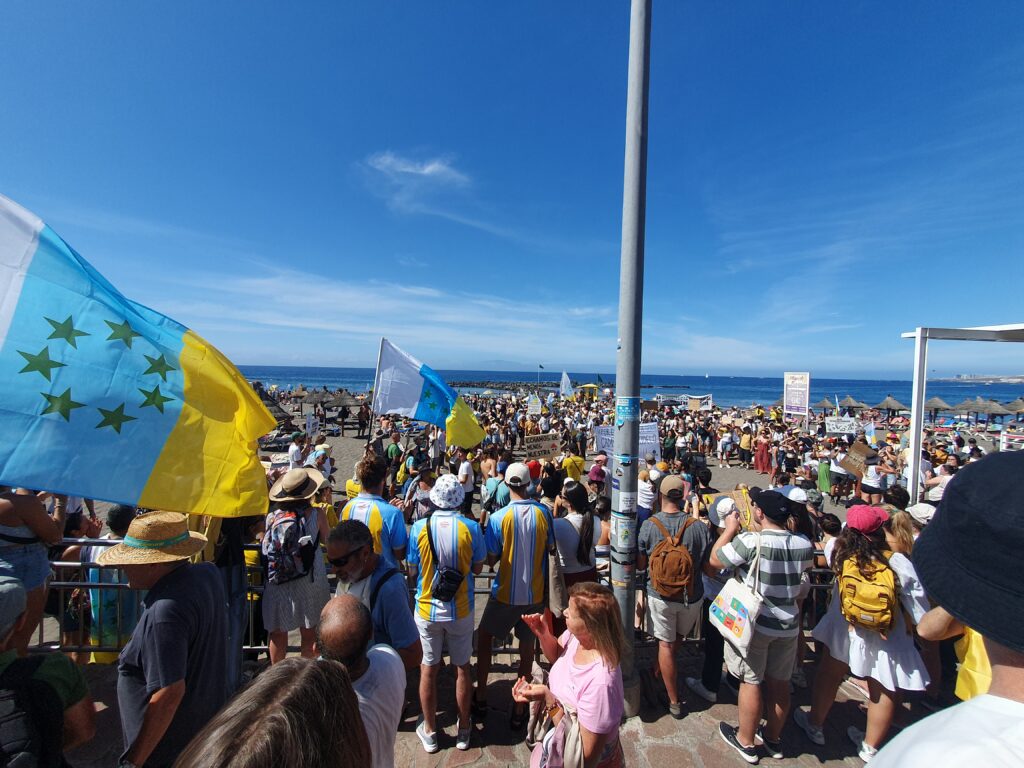
Sí se puede Canarias has called for the establishment of a genuine ecotax to improve and restore the Archipelago’s territory, highlighting the lack of progress by the regional government following large-scale public demonstrations defending the land over the past year.
Calls for Action
The organisation’s spokesperson, Vanesa Martín, described it as “scandalous” that the Canary Government has not taken any effective steps towards creating an ecotax. She argued that the stance maintained by Coalition Canaria, the Popular Party, the Gomera Socialist Group, and the Herreña Independent Group—partners in the government—alongside Vox, represents a commitment to an unsustainable developmental model that continues to favour territorial degradation.
Martín noted that Sí se puede has repeatedly pushed for discussions, both inside and outside the Canary Islands Parliament, regarding the economic and tourism model of the Islands. She emphasised the necessity of linking economic development with environmental protection and the quality of life for residents.
Criticism of Misguided Proposals
She also critiqued recent comments made by the President of the Tenerife Cabildo, Rosa Dávila, who equated charges for access to certain natural routes with an ecotax. “Charging for specific excursions or accesses does not reflect even a fraction of the actual costs incurred by tourism on our territory and public services,” she asserted.
In this context, she pointed out that numerous Canary municipalities are increasing waste fees to cover the effective costs of management, while the primary economic sector continues to avoid equivalent measures to offset its impact. “It is paradoxical that greater financial efforts are demanded from a population already experiencing some of the lowest incomes in the country, while the privileges of a sector generating enormous profits remain intact,” she commented.
Concerns Over Environmental Investment
Sí se puede further denounces the stark contrast between inadequate investment in environmental protection and the public resources allocated to bolster tourism promotion. The organisation highlighted that the Ministry of Tourism and Employment concluded the 2025 fiscal year with a budget execution of 292.9 million euros, of which over 25.4 million will be devoted to various promotional activities this year.
Notable allocations include over 9 million euros for “sun and beach” campaigns; nearly 5 million to attract so-called “remote workers”; over 4.3 million for promotion on search engines and social media; 3.5 million for the so-called “tourist product”; and an additional 3.4 million for actions aimed at executives and professionals from tour operators.
According to Martín, these public investments exacerbate existing issues like rising housing costs, crowded public spaces, and increasing pressure on coastal areas and island ecosystems.
Urgent Need for a Sustainable Model
Consequently, the spokesperson demands “a serious and brave debate on the economic model that Canary Islands need for the coming decades” and insists that the administrations heed proposals from citizen movements, the academic community, and various social sectors that have been warning about the territorial collapse facing the Archipelago.
“Public officials from the Canary Islands Government and the cabildos must listen to organised citizens. There are sound arguments and concrete measures to ensure compliance with environmental regulations and protect the territory we inhabit,” she emphasised.
Advocating for Comprehensive Changes
Finally, Martín advocated that the implementation of an ecotax, alongside a tourist moratorium and effective control of holiday rentals, would facilitate progress towards a more sustainable model. This could provide sufficient resources to restore natural spaces, eliminate coastal pollution, and enhance essential public services for residents, such as free public transport.