
– GOVERNMENT OF THE CANARY ISLANDS
SANTA CRUZ DE TENERIFE, 15 Jun. (EUROPA PRESS) –
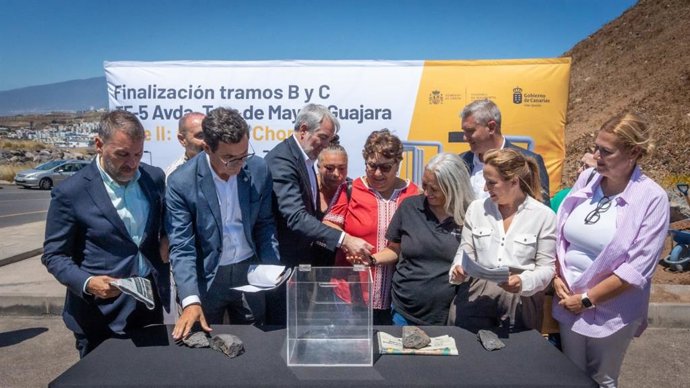
President of the Canary Islands, Fernando Clavijo, presided over the symbolic laying of the first stone for the completion of sections B and C of the TF-5, specifically the section between Avenida Tres de Mayo and Guajara, part of the second phase of the Ofra-El Chorrillo project. This strategic initiative will conclude a crucial infrastructure project for mobility in the metropolitan area of Tenerife.
The event was attended by the Minister of Public Works, Housing and Mobility of the Canary Islands Government, Pablo Rodríguez; the President of Tenerife’s Cabildo, Rosa Dávila; the Mayor of Santa Cruz de Tenerife, José Manuel Bermúdez; the Deputy Mayor of La Laguna, Francisco Hernández; the Director General of Road Infrastructure, Rosana Melián; the CEO of Roads at the Cabildo of Tenerife, Dámaso Arteaga; along with municipal representatives, the contracting company Señalizaciones Villar S.A., and community representatives from the area.
Among the attending associations were Manuel Torres, president of the El Draguillo Neighbourhood Association; Ramón Santiago, president of the Ciudad Satélite de Santa María del Mar Neighbourhood Association; and Sonia Rodríguez, president of the Las Moraditas platform, representing neighbourhoods directly impacted by the Ofra-El Chorrillo project.
During his address, Clavijo began by thanking the residents for their “patience, understanding, and perseverance” over the years while living with the inconveniences caused by such a long-awaited project.
The president emphasised that this initiative represents “many years of struggle” and a “complicated process” marked by technical, legal, and administrative hurdles.
Clavijo highlighted that “today we gather here with a contracted project that will enhance the area and provide this region with the connection it deserves.”
He noted that this project would improve access to the south and eliminate unnecessary detours, directly impacting the daily mobility of thousands of metropolitan residents.
The President of the Canary Islands also reiterated that there would be direct and constant supervision to ensure proper execution of the project. “Residents have waited long enough, and now the work will receive all the necessary oversight,” added Clavijo, who underscored that a significant part of the project is allocated to enhancing and integrating the surrounding landscape, addressing the requests made by local councils and affected neighbourhoods.
Additionally, Clavijo stated that “this project exemplifies how inter-administrative collaboration can unlock vital initiatives for citizens.”
He insisted that this project had been stalled for years but is now progressing due to the shared commitment of institutions to meet one of Tenerife’s major mobility demands.
Minister Pablo Rodríguez mentioned that “the future direct connection between the TF-2 and TF-5 will strengthen the connectivity of the metropolitan area and help to reduce congestion in one of the island’s main traffic corridors.” He added that “one of our priority objectives since the start of this legislative term has been to revive projects that have long been stalled.”
LEGAL AND ADMINISTRATIVE COMPLEXITY
Thus, “the Ofra-El Chorrillo project is an example of this, a key infrastructure that we have successfully revitalised after years of stagnation, thanks to the significant technical and administrative work carried out by the Road Infrastructure Directorate General to overcome the legal and administrative complexities associated with this endeavour and make it possible for works to become a reality today,” he commented.
On her part, Rosa Dávila, the President of the Cabildo of Tenerife, clarified that the final awarding of the phase II works between Ofra and El Chorrillo “represents a decisive step towards further improving mobility in the metropolitan area of Tenerife.”
Dávila added that “this initiative will enhance connectivity between neighbourhoods, increase traffic flow, and improve safety for commuters, integrating into a broader strategy promoted by the Cabildo in conjunction with the Government of the Canary Islands to tackle one of the island’s main challenges.”
She pointed out that projects such as the Padre Anchieta footbridge, the third lane of the TF-5, improvements to strategic junctions, and enhancements to public transport “are part of a long-term plan that is already beginning to yield real improvements for citizens and a more efficient, safe, and sustainable mobility framework.”
THE PROJECT
The works have been awarded to Señalizaciones Villar S.A. for a total of €5,847,749.72.
The project aims to complete sections B and C of the Ofra-El Chorrillo route, a strategic infrastructure to improve connectivity between Santa Cruz de Tenerife and La Laguna, optimising traffic flow within the metropolitan area.
The Ofra-El Chorrillo route is part of the La Salud-El Chorrillo axis and is included in Tenerife’s primary spatial and roadway planning instruments.
The works involve the implementation of sections B and C of the infrastructure.
Section B extends from the Moraditas roundabout to the San Matías roundabout, connecting with the neighbourhood of the same name and El Abandono street.
Section C links the San Matías roundabout with the TF-2 road, completing a crucial connection for improving the road network in the metropolitan area.
The completion of these phases is especially relevant due to the current temporary conditions in the area, where various traffic diversions remain in place to ensure communication between neighbourhoods, according to a government statement.
Once the works are completed, the capacity of the road network, commuter safety, and traffic flow will be improved in one of the island’s busiest traffic environments.
Furthermore, unlike section A, the execution of sections B and C presents less technical complexity, as the main infrastructure proposed in the project, the bridge over Barranco del Muerto, has already been constructed.
The project also includes significant improvements and enhancements to the surrounding area, aiming to integrate the infrastructure into the urban landscape and address the needs communicated by local councils and residents of the impacted neighbourhoods.