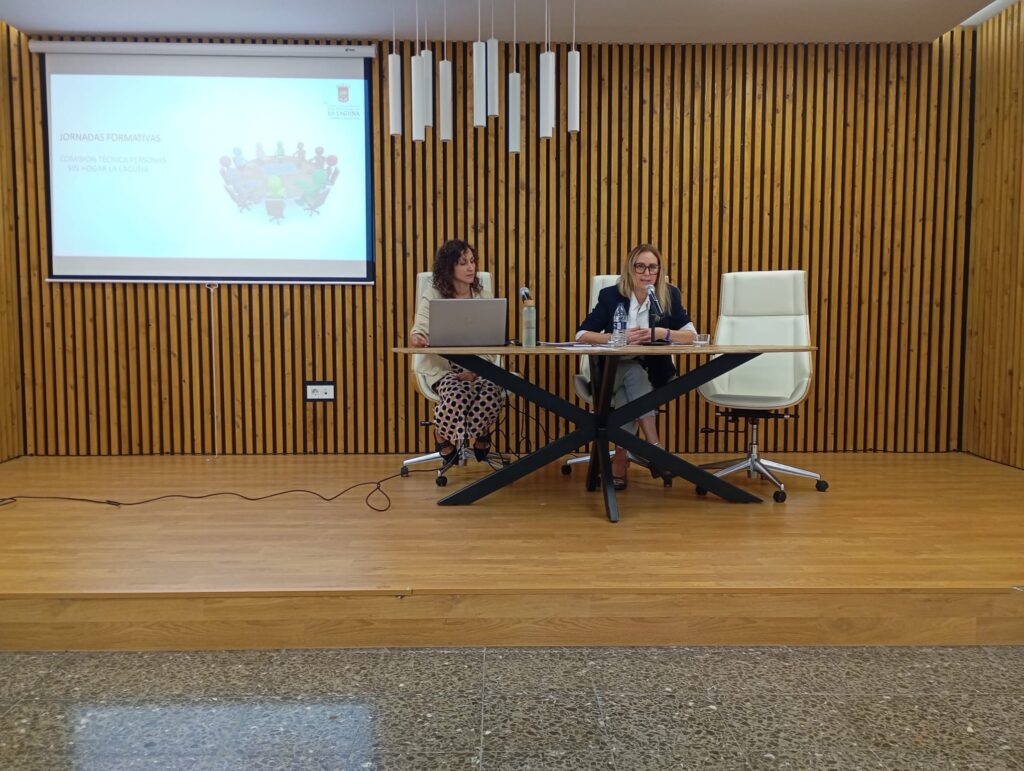
The City Council of La Laguna has held the inaugural edition of the Homeless Technical Commission Conference this week. This event served as a meeting and training space focused on social risk situations, bringing together public administrations and various entities and groups. Topics of interest such as comprehensive care, mental health, and community intervention were discussed through lectures and presentations.
Formation of the Technical Commission
Established in the municipality in 2021, the Technical Commission is led by the Department of Social Welfare and Quality of Life. It includes the Assertive Community Health Team (HUNSC-SCS), the Mental Health Unit of La Laguna, and other organisations addressing the extreme social vulnerability of homeless individuals, such as U.M.A.C from Cáritas, the Red Cross, San Miguel Adicciones, the Don Bosco A.F.E.S Mental Health Foundation, Médecins du Monde, and the Municipal Alternative Housing Service – MUVISA.
Efforts in Social Welfare
The Councillor for Social Welfare and Quality of Life, María Cruz, explained that this department is making significant efforts to solidify resources and support for those experiencing residential exclusion. However, current data reflects a growing reality that necessitates further advancement, strengthening both available tools and technical coordination spaces.
“Thus, training, sharing experiences, and creating such spaces are fundamental to improving intervention quality and ensuring more effective responses that cater to the needs of vulnerable individuals,” the councillor added.
The local representative emphasised that “this line of work must be intensified across all areas, considering the data trends from recent years, which show an increase in individuals lacking housing resources across virtually all regions nationally and internationally.”
Conference Programme
The agenda for the event began with a presentation on the work of the Homeless Technical Commission of La Laguna, led by technical representative Talía Gómez. This was followed by contributions from several members and researchers of Cáritas Diocesana, including José Antonio Díez, Silvia Gutiérrez, Felipe Estévez, and Elena Murcia, who discussed the specific situation in La Laguna, the support provided in the municipality, and findings from the Extreme Residential Exclusion Study in Tenerife. The first segment concluded with Juan Ojeda (psychiatrist of ECA) addressing homelessness and its impact on mental health.
After a brief break, Nuria Leandro, a representative of the Mental Health Unit of La Laguna and Tacoronte, spoke about the primary challenges regarding dual pathology. Subsequently, Víctor Sosa and Juan Carlos Dugo from the Red Cross discussed other disadvantaged groups.
The conference concluded with three additional talks: Sara Domínguez and Sara Tadeo from AFES Mental Health, addressing mental health support in homelessness; Mónica Estévez and Patricia Ortiz from AFES discussing the right to health and inclusion in the context of migration; and Jusnievi Pérez from the Youth Emancipation Programme, who presented the Buzzeti Programme in San Cristóbal de La Laguna.