
– ÁLEX ROSA (PARLAMENTO DE CANARIAS) – Archivo
SANTA CRUZ DE TENERIFE, 3 June (EUROPA PRESS) –
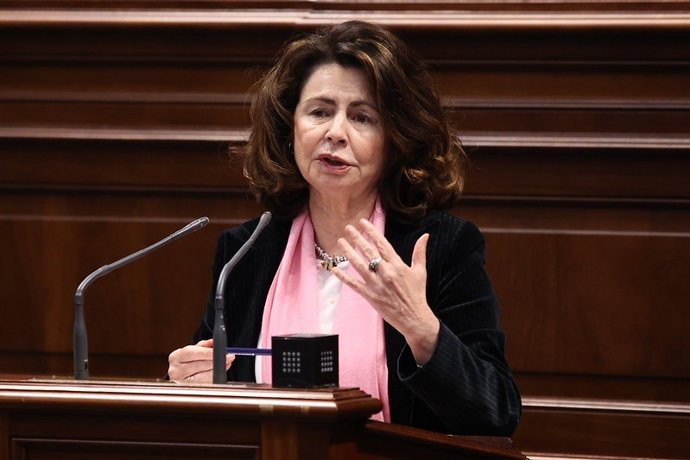
The Canary Islands’ Minister of Finance, Matilde Asián, has described as “nonsense” the idea that Ceuta and Melilla could acquire a status similar to that of the Outermost Regions (RUP). She assured that there is “absolute tranquillity” regarding the regime enjoyed by the archipelago.
Responding to a question from the Nationalist Group, which demanded “firmness” from the government through MP José Manuel Bermúdez, the minister indicated that the two autonomous cities have their own regime that is “entirely different” from that of the Canary Islands, marked by their remoteness and insularity.
“We receive compensation for additional costs because we are an ultra-peripheral region, while they must have a specific regime due to their circumstances as small cities or lack of significant economic activities,” she commented.
Asián acknowledged Ceuta and Melilla’s claims, as they even have “fewer competitive opportunities” than the Canary Islands. However, she asserted that they “absolutely” cannot be included among the characteristics of ultra-peripheral regions.
“We bear no resemblance to Ceuta and Melilla, aside from having structural deficiencies. However, they certainly do not have ultra-peripheral status because they are very close to the mainland,” she noted.
The minister remarked that the debate is “artificial,” despite the president of the PP, Alberto Núñez Feijóo, raising it during a recent visit to Ceuta. She also does not endorse the statements made by economist Javier Sánchez Ruano regarding the risks looming over the archipelago.
In this context, she stated that several EU regions have claims for obtaining “compensations,” for example, if they are mountainous or depopulated. However, “this cannot be achieved overnight,” nor can it be undertaken through Article 349 of the EU treaty.
VIGILANT AND PROACTIVE POSITION
Bermúdez (CC) mentioned that his group does not wish to confront or question the legitimate aspirations of Ceuta and Melilla. However, he expressed concern about the “attempt to advance towards new recognition formulas that could dilute or undermine the legal, political, and institutional uniqueness that the Canary Islands have achieved with great effort within the European Union.”
He commented that there are upcoming European and state reforms that “could potentially question” essential instruments for the Canary Islands, such as the REF or policies related to ultra-peripheral status. Therefore, he finds it “reasonable” to question whether certain proposals might spark a debate over the uniqueness of the RUP.
The nationalist MP also pointed out that Ceuta and Melilla aspire to have their own “representation” on the Committee of the Regions and urged a continuous defence of the priorities and influence of the Canary Islands.
“That is why we consider it essential for the Canary Islands government to maintain a vigilant and proactive position, not to prevent other territories from advancing in the recognition of their singularities, but to ensure that no advancement by others results in a setback for the Canary Islands,” he affirmed.